Why Businesses Are Migrating from Legacy ERP to Odoo
05 August 2026
Introduction
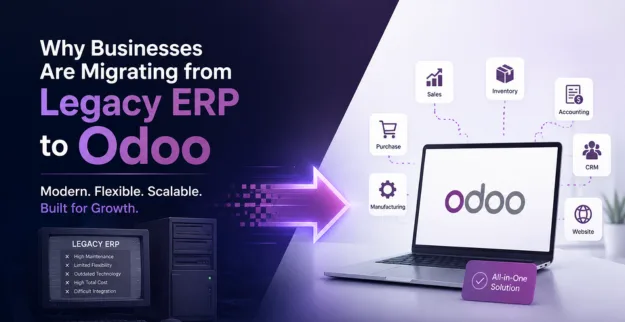
Many businesses still rely on legacy ERP systems that were implemented years ago to manage finance, inventory, procurement, sales, and other business operations. While these systems once met organizational needs, they often struggle to keep pace with modern business requirements. High maintenance costs, limited scalability, outdated technology, and poor integration capabilities make legacy ERP systems increasingly difficult to manage.
Legacy ERP Challenges
Traditional ERP systems often become barriers to business growth as technology evolves.
1. High Maintenance Costs
Legacy ERP systems require expensive hardware, software licenses, and ongoing maintenance, increasing the total cost of ownership.
2. Limited Flexibility
Many older ERP platforms are difficult to customize, making it challenging to adapt to changing business processes and customer demands.
3. Poor Integration
Legacy systems often struggle to integrate with cloud applications, CRM platforms, eCommerce websites, and third-party business tools.
4. Outdated User Experience
Complex interfaces and manual processes reduce employee productivity and increase training requirements.
5. Limited Scalability
As businesses grow, legacy ERP systems may not efficiently support new users, locations, products, or business operations.
These challenges encourage organizations to consider modern ERP solutions such as Odoo ERP.
Why Odoo?
Odoo ERP provides an integrated business management platform that simplifies operations while supporting future business growth.
Why Businesses Choose Odoo
- Modular architecture that grows with your business
- User-friendly and modern interface
- Lower implementation and maintenance costs
- Cloud and on-premise deployment options
- Easy integration with third-party applications
- Real-time dashboards and business reporting
- Highly customizable to business requirements
Unlike many traditional ERP systems, Odoo allows businesses to implement only the modules they need and expand as their operations grow.
Migration Process
A successful ERP migration requires careful planning and execution to minimize business disruption.
Assessment & Planning
Evaluate the existing ERP system, identify business requirements, and define project objectives.
Data Migration
Clean, validate, and migrate customer records, financial data, inventory, suppliers, and other business information into Odoo ERP.
System Configuration
Configure Odoo modules, workflows, user roles, approvals, and reports based on business requirements.
Testing
Conduct User Acceptance Testing (UAT) to verify system functionality, integrations, and data accuracy before deployment.
Go-Live & Support
Deploy the new system, train employees, monitor performance, and provide ongoing support after implementation.
Working with an experienced Odoo implementation partner helps ensure a smooth transition with minimal downtime.
Benefits
Migrating from a legacy ERP system to Odoo provides several long-term business advantages.
Business Benefits
- Reduced operational and maintenance costs
- Improved process automation
- Faster access to business information
- Better collaboration across departments
- Enhanced reporting and decision-making
- Greater scalability for future growth
- Improved customer and supplier management
- Easier integration with cloud applications
Odoo enables organizations to operate more efficiently while supporting digital transformation initiatives.
Migration Checklist
Before starting your Legacy ERP to Odoo migration, ensure the following:
- Define business objectives and project scope
- Identify required Odoo modules
- Review existing business processes
- Clean and validate legacy data
- Plan integrations with third-party systems
- Conduct employee training
- Perform comprehensive system testing
- Prepare backup and rollback plans
- Arrange post-implementation support
Following this checklist reduces implementation risks and improves project success.
Conclusion
Migrating from Legacy ERP to Odoo is more than a software upgrade—it is a strategic investment in business growth and operational efficiency. Modern businesses require flexible, scalable, and integrated ERP solutions that can adapt to changing market demands, and Odoo ERP delivers exactly that.
FAQ
1. Why do businesses migrate from legacy ERP systems to Odoo?
Businesses migrate to reduce maintenance costs, improve scalability, automate business processes, enhance reporting, and support digital transformation.
2. What is involved in an ERP migration?
ERP migration includes system assessment, data migration, module configuration, testing, user training, deployment, and post-implementation support.
3. Is migrating to Odoo difficult?
With proper planning and an experienced implementation partner, Odoo migration can be completed smoothly with minimal disruption to business operations.