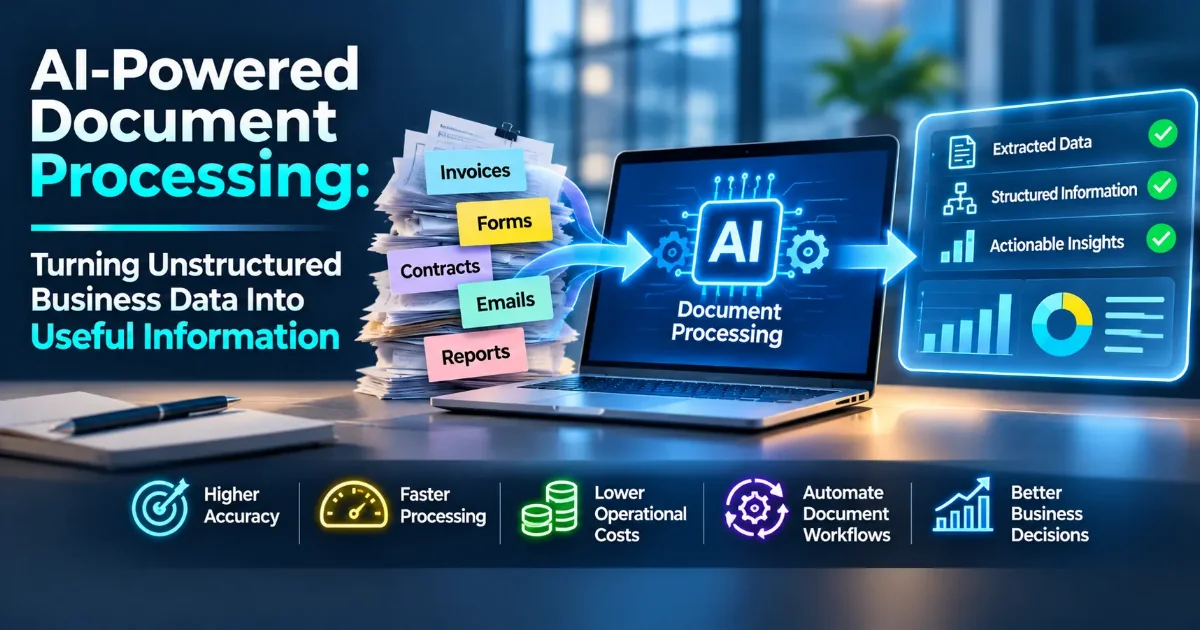
AI-Powered Document Processing: Turning Unstructured Business Data Into Useful Information
By: Ganesan D
24 Nov 2026
Category:
Custom
Introduction
A large amount of information is handled in businesses in the form of invoices, contracts, emails, application forms, purchase orders and more. Often this data will be in an unstructured format, causing inefficiencies when data must be manually captured, categorised and retrieved.
AI document processing solutions apply AI, OCR and ML technologies to allow businesses to interpret, categorise and extract meaningful information from a range of documents. This means previously fragmented data can be turned into structured data to be used within businesses for reporting, decision making and automation.
In the UAE, implementing AI document processing solutions within businesses can be an efficient method for improving document management and reducing repetitive administration tasks.
Structured vs. Unstructured Business Data
Business information is generally available in two main formats: structured data and unstructured data. Understanding the difference helps organisations identify where AI-powered document processing can provide value.
-
Structured Data:
This is data in a set format. It may be in a database table, spreadsheet or accountancy system. Data can include customer names, invoice numbers and amounts. Data is organised in a clear and consistent format.
-
Unstructured Data:
This is data which is not in a set format. This could include scanned documents, emails, contracts, handwritten forms and PDF files.
In traditional systems, structured data can be efficiently processed, but different layouts, formats and styles of documents make unstructured information difficult to manage.
Using AI to process documents makes it possible to extract key information from unstructured data and convert it into structured data for further business use.
Document Classification: Identifying Document Types
AI systems analyse information from documents, such as words, key phrases and layouts, to identify the type of document being processed.
For example, if an organisation receives multiple different documents, such as invoices, delivery notes, purchase orders and new employee applications, into the same email inbox, AI can identify each document type and send it to the correct department or processing workflow.
This means documents do not need to be manually sorted, allowing employees to manage business information more efficiently.
Information Extraction: Capturing Relevant Details
AI-powered document processing extracts important information from within each document. For example, the key data extracted from an invoice may include:
- Supplier Name and Contact Details
- Invoice Number
- Invoice Date
- Purchase Order Number
- Tax and Total Amount Owed
- Payment Due Date
Compared to basic OCR software, AI can understand the context of a document and determine which specific data fields the extracted information relates to. This means intelligent document processing in the UAE can be particularly useful for handling documents with different layouts and formats.
Data Validation and Accuracy
Data validation helps ensure that the extracted information is accurate before it is used for business purposes. Inaccurate data may cause issues within financial records, customer databases and business decisions.
Validation rules can be configured in AI document processing tools to check:
- Whether all required fields contain data.
- Whether invoice totals and tax values are correct.
- Whether supplier and customer details are accurate.
- Whether duplicate documents have been identified.
- Whether extracted information is consistent with existing business records.
Unclear information or data with a low confidence level can be passed to an employee for manual verification. Combining automated validation with human review helps maintain data quality and accuracy.
Workflow Integration and Business Applications
AI document processing can help integrate and improve processes within applications across many industries, including ERP systems, CRM systems, accounting software and document management systems.
For example, invoices can be processed and validated, with the extracted information transferred into accounting software for review and approval. This reduces manual data entry and helps streamline financial workflows.
Common applications across different business departments include:
-
Finance:
Processing invoices, expenses, payment records and financial documents.
-
Human Resources:
Processing resumes, employee onboarding documents and job applications.
-
Procurement:
Managing purchase orders, supplier documents and delivery notes.
-
Customer Services:
Processing customer forms, queries and supporting documentation.
-
Regulatory Compliance:
Organising documents, retrieving relevant information and supporting document reviews.
These applications help businesses automate document-related processes and make important information more accessible to the relevant teams.
Frequently Asked Questions
1. What Is AI-Powered Document Processing?
AI-powered document processing uses artificial intelligence and machine learning to classify documents, extract relevant information and transform unstructured content into useful structured digital data.
2. Is AI Document Processing Different from OCR?
Yes. OCR primarily converts text from scanned documents and images into machine-readable text. AI-powered document processing goes further by understanding document context, identifying document types and extracting specific information from different formats.
3. Can AI Process Scanned PDFs and Handwritten Forms?
Several AI document processing systems support scanned PDFs and handwritten forms. However, extraction accuracy depends on image quality, handwriting clarity, language support and the capabilities of the selected solution.
4. Can AI Document Processing Integrate with ERP Systems?
Yes. Extracted and validated information can be transferred to ERP and other business applications through APIs or compatible integration connectors, helping organisations streamline their existing workflows.
Conclusion
AI-powered document processing allows businesses to extract meaningful information from unstructured documents and convert it into useful digital data. By classifying, extracting, validating and integrating document information, organisations can improve operational efficiency, reduce manual workloads and make business information easier to access.
At Agan Cyber Security LLC, we can assist you in finding secure technology solutions to digitally transform your business and improve operational efficiency. Contact us today to explore document automation solutions for your organisation. We provide intelligent automation solutions in Dubai and throughout the UAE.