AI vs Human Analysts in Threat Detection
24 August 2026
Introduction
Cyber threats are becoming faster, more complex, and increasingly difficult to identify using traditional security methods. Organizations now use artificial intelligence to analyze large volumes of security data, identify suspicious patterns, and prioritize potential threats. At the same time, experienced Security Analysts remain essential for investigating alerts, understanding attacker behavior, and making critical security decisions.
The debate between AI Threat Detection and human expertise is therefore not simply about choosing one over the other. A strong cybersecurity strategy combines the speed and scale of AI in Cyber Security with the experience and judgment of skilled security professionals.
AI vs Human Analysts
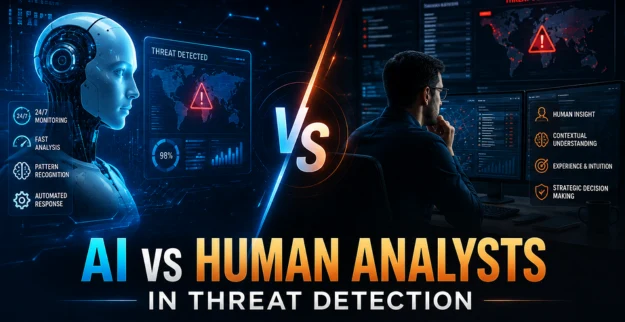
AI and human analysts approach Threat Detection differently.
AI Threat Detection
AI systems can analyze large amounts of data and identify patterns that may indicate malicious activity.
AI can:
- Analyze security events at high speed
- Identify unusual user and network behavior
- Correlate information from multiple security sources
- Prioritize large volumes of security alerts
- Detect patterns across historical security data
- Support automated security responses
AI is particularly valuable in environments where security teams receive thousands of alerts every day.
Human Security Analysts
Human analysts bring contextual understanding, experience, and decision-making capabilities to cybersecurity operations.
Security analysts can:
- Investigate complex security incidents
- Validate suspicious alerts
- Understand business context
- Analyze attacker behavior
- Determine the potential impact of an incident
- Make strategic response decisions
Humans are particularly important when an incident requires judgment, investigation, or coordination across different teams.
Strengths & Weaknesses
AI Strengths
- Extremely fast data processing
- Continuous monitoring capability
- Handles large volumes of security events
- Identifies patterns and anomalies
- Reduces repetitive manual analysis
AI Limitations
- May generate false positives
- Can lack business context
- Requires quality data and appropriate configuration
- Complex incidents may require human interpretation
Human Strengths
- Critical thinking and judgment
- Understanding of business context
- Flexible investigation capabilities
- Ability to analyze unfamiliar attack scenarios
- Effective communication and decision-making
Human Limitations
- Limited processing capacity compared with automated systems
- Alert fatigue can affect performance
- Requires ongoing training and expertise
- 24/7 coverage can require significant resources
Real-World Use Cases
Security Monitoring
AI can continuously analyze logs, endpoint activity, network traffic, and user behavior. Human analysts can then investigate high-priority alerts and determine whether they represent genuine threats.
Phishing Detection
AI can analyze email patterns, URLs, attachments, and sender behavior to identify suspicious messages. Analysts can investigate sophisticated phishing campaigns and determine their potential impact.
Ransomware Detection
AI can identify unusual file activity and behavioral patterns associated with ransomware. Security analysts can investigate affected systems and coordinate containment and recovery.
Incident Investigation
AI can quickly correlate security events across multiple systems, while analysts use the collected information to understand the attack path and determine appropriate response actions.
AI can help identify unusual patterns that may otherwise be difficult to detect. Analysts can investigate these findings and actively search for additional indicators of compromise.
Future Trends
The future of AI in Cyber Security is likely to focus increasingly on collaboration between intelligent systems and human security professionals.
Organizations are expected to use AI for:
- Automated alert prioritization
- Faster threat correlation
- Behavioral analysis
- Security workflow automation
- Threat intelligence analysis
Meanwhile, Security Analysts will continue focusing on complex investigations, strategic decisions, threat hunting, and incident response.
The goal is not to replace human analysts but to enable them to work more efficiently by reducing repetitive tasks and providing better security insights.
Conclusion
AI Threat Detection and human security analysts each provide valuable capabilities. AI offers speed, scale, continuous monitoring, and automated analysis, while human analysts provide experience, contextual understanding, critical thinking, and strategic decision-making.
For most organizations, the strongest approach is to combine both. AI can process large volumes of security data and highlight potential threats, while experienced Security Analysts investigate those threats and determine the appropriate response.
By combining AI in Cyber Security with human expertise, organizations can improve Threat Detection, reduce response times, and build a more effective and resilient security operation.