How to Protect Sensitive Data in an ERP System
By: Ganesan D
8 Oct 2026
Category:
Cyber Security
Introduction
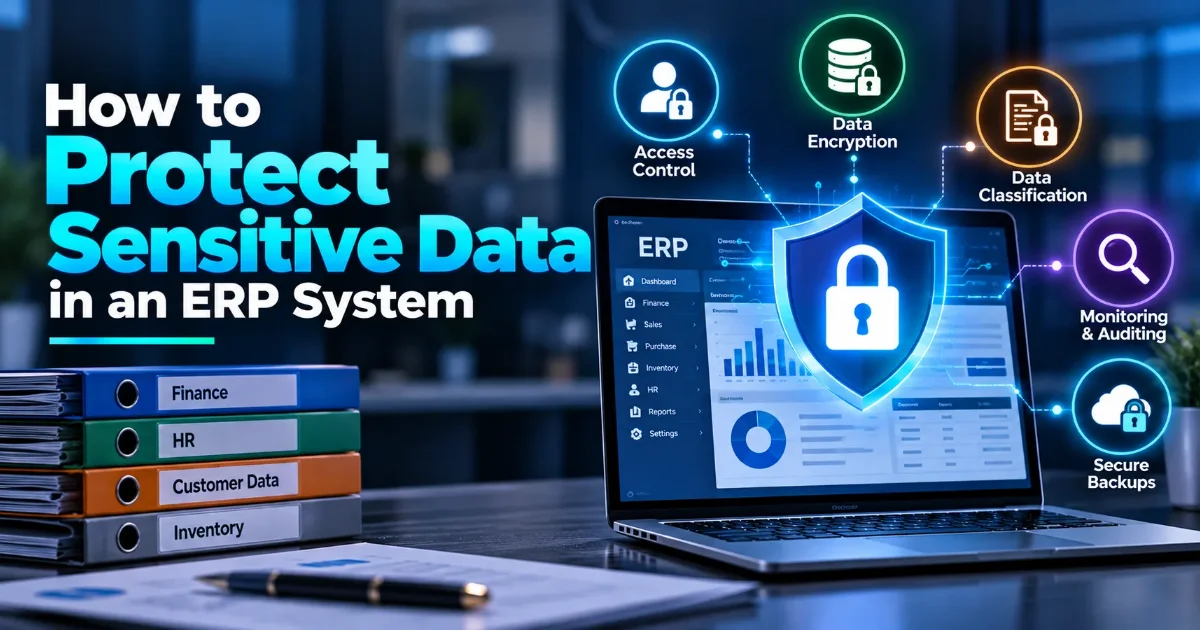
Enterprise Resource Planning (ERP) systems centralize critical business information, including financial records, customer details, employee data, inventory, purchases, and sales information. Because ERP platforms contain valuable data, they can become attractive targets for cybercriminals.
Strong ERP Security is therefore essential for protecting sensitive information from unauthorized access, data loss, and cyberattacks. Businesses should combine access controls, authentication, encryption, monitoring, backups, and other ERP Cyber Security practices to reduce data risk.
Identify ERP Data Risks
The first step is understanding what data the ERP system stores and where potential weaknesses exist.
Common ERP data risks include:
-
Unauthorized user access
-
Stolen or compromised credentials
-
Excessive user permissions
-
Data leakage
-
Malware and ransomware
-
Insecure integrations and APIs
-
Misconfigured systems
-
Accidental data deletion
Businesses should classify sensitive information and identify which users, applications, and systems require access to it.
Implement Strong Access Controls
Access should be based on each employee's job responsibilities.
Organizations should:
-
Apply role-based access controls
-
Follow the principle of least privilege
-
Review user permissions regularly
-
Remove access when employees leave
-
Restrict access to sensitive financial and customer data
Limiting unnecessary permissions can reduce the potential impact of compromised accounts.
Strengthen Authentication
Strong authentication helps prevent attackers from accessing ERP accounts using stolen credentials.
Businesses should consider:
-
Multi-factor authentication (MFA)
-
Strong password policies
-
Secure password management
-
Conditional access controls
-
Account lockout and login monitoring
MFA provides an additional layer of protection beyond usernames and passwords.
Use Encryption
Encryption helps protect sensitive ERP information from unauthorized access.
Organizations should consider encryption for:
-
Data in transit: Protect information moving between users, applications, and ERP services.
-
Data at rest: Protect stored databases, files, and backups.
Encryption should be combined with proper key management and access controls.
Monitor ERP Activity
Continuous monitoring can help identify suspicious activity and potential data risk.
Security teams should monitor:
-
Failed login attempts
-
Unusual user activity
-
Privilege changes
-
Access to sensitive records
-
Data exports and downloads
-
Administrative actions
Organizations can use appropriate data protection tools, logging, SIEM, and security monitoring solutions to detect and investigate unusual ERP activity.
Maintain Secure Backups
Regular backups are essential for protecting ERP data against accidental deletion, system failures, ransomware, and other incidents.
Businesses should:
-
Maintain regular backups
-
Protect backup access with strong authentication
-
Encrypt sensitive backups
-
Keep appropriate offline or isolated copies
-
Test restoration procedures regularly
A backup strategy is only effective if the organization can successfully restore its data when required.
ERP Security Best Practices
A strong ERP Cyber Security strategy should include:
-
Regular vulnerability assessments
-
Timely security updates and patches
-
Secure API and third-party integrations
-
Employee security awareness training
-
Regular access reviews
-
Incident response planning
-
Continuous security monitoring
-
Periodic security testing
Organizations should also review ERP security whenever major system changes, integrations, or new modules are introduced.
Conclusion
Protecting sensitive ERP information requires a layered approach. Strong access controls, authentication, encryption, monitoring, secure backups, and regular security assessments can significantly reduce data risk.
By treating ERP Security as an ongoing process rather than a one-time configuration, businesses can better protect financial, customer, employee, and operational information stored within their ERP environment.
Strengthen Your ERP Security
Protecting sensitive ERP data requires strong access controls, secure authentication, encryption, monitoring, backups, and continuous security assessments. Agan Cyber Security LLC helps businesses strengthen their cybersecurity strategy and protect critical business information.
Contact us today to strengthen your ERP security.