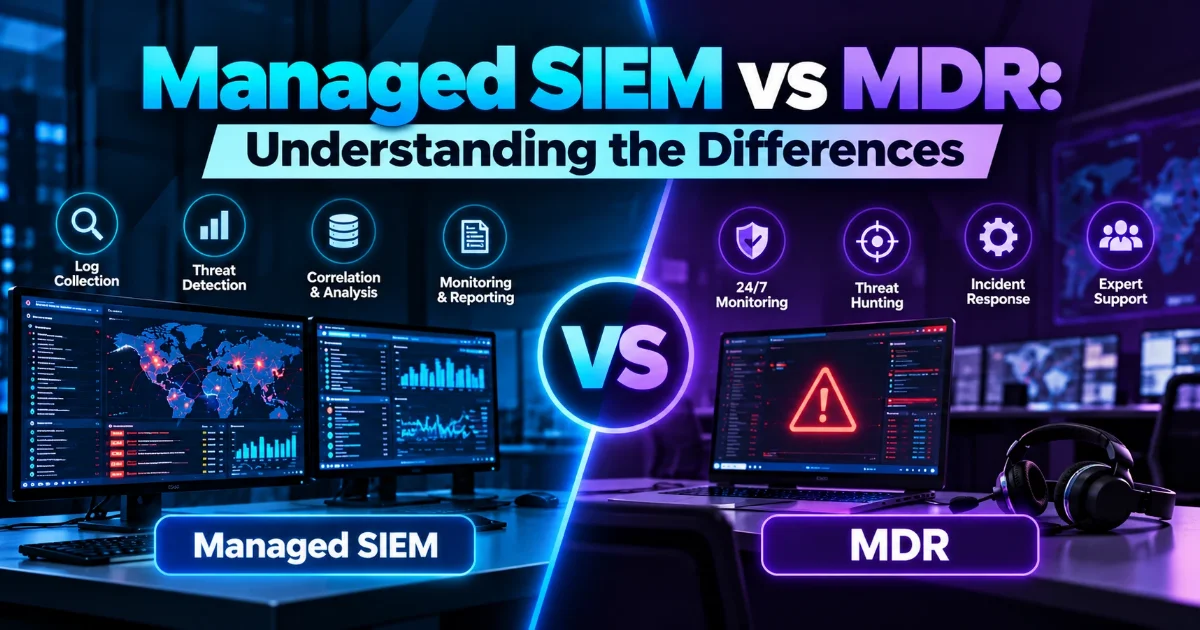
Managed SIEM vs MDR: Understanding the Differences
By:
Ganesan D
6 Oct 2026
Category:
Cyber Security
Introduction
Businesses need continuous security monitoring to identify suspicious activity and respond to cyber threats. Two services organizations commonly consider are Managed SIEM and Managed Detection and Response (MDR).
Although MDR vs SIEM are sometimes used interchangeably, they provide different capabilities. Understanding Managed SIEM vs MDR can help businesses determine which approach better fits their security requirements.
What is Managed SIEM?
Managed SIEM is a service where security professionals manage and monitor a SIEM (Security Information and Event Management) platform on behalf of an organization.
The service typically includes:
- Log collection and monitoring
- SIEM configuration and tuning
- Security alert monitoring
- Event correlation
- Threat detection
- Alert investigation and escalation
Managed SIEM focuses heavily on collecting and analyzing security data from multiple sources and providing centralized visibility.
What is MDR?
Managed Detection and Response (MDR) is a security service focused on detecting threats and supporting response activities.
MDR typically combines security technologies with security analysts who investigate suspicious activity and help organizations respond to threats.
Services may include:
- Continuous threat monitoring
- Threat detection
- Alert investigation
- Threat hunting
- Incident investigation
- Containment and response support
MDR can use multiple security technologies, including endpoint, network, identity, and cloud security tools.
Monitoring and Detection
Managed SIEM primarily focuses on centralized security event monitoring and log analysis.
MDR focuses more broadly on detecting and investigating threats across multiple security layers.
For example, Managed SIEM may correlate authentication, firewall, and server logs to identify suspicious activity, while MDR may combine endpoint telemetry, identity events, network activity, and threat intelligence to investigate the potential threat.
Incident Response
Managed SIEM services commonly identify and escalate suspicious events. The level of incident response depends on the service agreement.
MDR generally provides a stronger focus on investigation and response. Depending on the provider and service scope, MDR may support containment, remediation, threat hunting, and other response activities.
Managed SIEM vs MDR: Key Differences
| Factor |
Managed SIEM |
MDR |
| Primary Focus |
Log and event monitoring |
Threat detection and response |
| Data Sources |
Primarily logs and security events |
Multiple security telemetry sources |
| Threat Detection |
SIEM rules and analytics |
Detection, analytics, threat hunting |
| Investigation |
Alert investigation |
Deeper threat investigation |
| Response |
Usually escalation/support |
Often includes response support |
| SOC Integration |
Strong |
Strong |
| Best For |
Centralized visibility |
Managed detection and response |
Business Use Cases
Choose Managed SIEM When:
- You need centralized log monitoring
- You want SIEM expertise without managing it internally
- You need security event correlation
- You already have an incident response capability
- Compliance or audit logging is an important requirement
Consider MDR When:
- You need continuous threat detection
- You have limited internal security resources
- You need threat hunting capabilities
- You require support during security incidents
- You want a broader managed security service
Some organizations may use both SIEM and MDR, with SIEM providing centralized security visibility while MDR provides additional detection, investigation, and response capabilities.
Conclusion
SIEM vs MDR is not simply a comparison of two identical services. Managed SIEM primarily provides centralized log collection, event correlation, monitoring, and alerting, while MDR focuses more broadly on threat detection, investigation, hunting, and response.
The right approach depends on an organization's security maturity, technology environment, internal expertise, and response requirements.