SOC Team Structure: Key Roles in a Security Operations Center
By:
Ganesan D
5 Oct 2026
Category:
Cyber Security
Introduction
A Security Operations Center (SOC) is responsible for continuously monitoring an organization's technology environment, identifying potential security threats, investigating suspicious activity, and supporting incident response.
Understanding Security Operations Center roles and responsibilities can help businesses build an effective SOC Team and establish a structured approach to Security Operations.
What is a SOC Structure?
A SOC structure defines how security professionals, technologies, processes, and responsibilities are organized to monitor and protect an organization's IT environment.
A typical SOC may include:
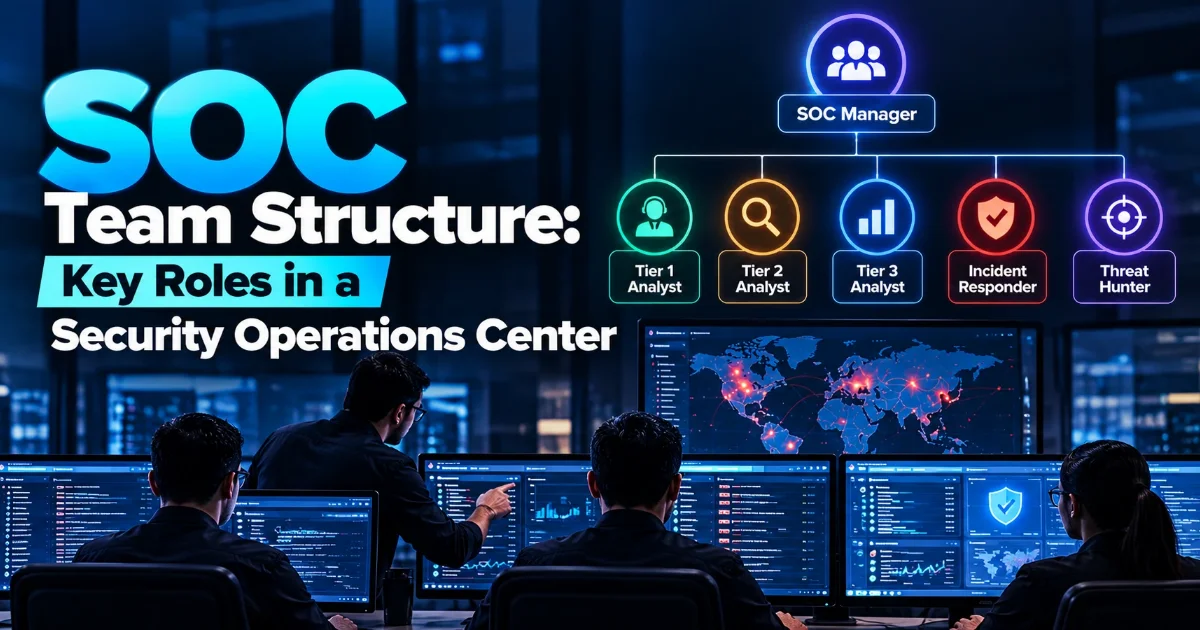
- SOC Manager or Security Operations Manager
- Tier 1 Security Analysts
- Tier 2 Security Analysts
- Tier 3 Security Analysts
- Incident Response Specialists
- Threat Hunters
- Security Engineers
- Threat Intelligence Specialists
The exact structure depends on the organization's size, security requirements, technology environment, and whether security monitoring is performed internally or through a Managed SOC provider.
Key SOC Roles and Responsibilities
SOC Manager
The SOC Manager oversees the overall Security Operations function.
Typical responsibilities include:
- Managing the SOC team
- Defining monitoring processes
- Establishing security procedures
- Managing performance and reporting
- Coordinating incident response activities
- Supporting security strategy and improvements
The SOC Manager also helps ensure that analysts, processes, and technologies work together effectively.
Tier 1 SOC Analyst
Tier 1 analysts are generally responsible for initial alert monitoring and triage.
Their responsibilities may include:
- Monitoring security alerts
- Reviewing SIEM notifications
- Validating potential security events
- Prioritizing alerts
- Investigating basic indicators
- Escalating suspicious incidents
Tier 1 analysts help filter routine or low-priority events from incidents that require deeper investigation.
Tier 2 SOC Analyst
Tier 2 analysts perform deeper investigations into suspicious security events.
Their responsibilities may include:
- Investigating escalated alerts
- Correlating security events
- Analyzing endpoint and network activity
- Determining the scope of incidents
- Identifying attack techniques
- Supporting containment activities
Tier 2 analysts may also work with incident response teams when an event is confirmed as a security incident.
Tier 3 SOC Analyst
Tier 3 analysts typically handle complex investigations and advanced security analysis.
Their responsibilities can include:
- Investigating sophisticated attacks
- Performing advanced threat analysis
- Developing detection rules
- Conducting malware or forensic analysis
- Supporting threat hunting
- Improving security controls
Tier 3 analysts may also help identify weaknesses in existing detection capabilities and develop new techniques for identifying advanced threats.
Incident Response Team
Incident response specialists focus on managing confirmed or suspected security incidents.
Their activities may include:
Detection → Investigation → Containment → Eradication → Recovery → Lessons Learned
They work closely with SOC analysts to understand the incident, determine its impact, contain affected systems, remove the threat, and support recovery.
Threat Hunting
Threat hunting is a proactive security activity in which security professionals search for signs of malicious or suspicious activity that may not have generated a conventional security alert.
Threat hunters may analyze:
- Endpoint activity
- Network traffic
- Authentication events
- SIEM data
- Threat intelligence
Threat hunting can help identify previously undetected activity and improve the organization's detection capabilities.
How SOC Teams Work Together
A SOC operates as a collaborative environment rather than a collection of independent roles.
A typical workflow may look like:
Security Event → Tier 1 Triage → Tier 2 Investigation → Tier 3 Analysis → Incident Response
For example, a SIEM may generate an alert for unusual account activity. A Tier 1 analyst reviews the alert and determines whether it requires escalation. If suspicious, the event moves to Tier 2 for deeper investigation.
If the investigation reveals a sophisticated or complex attack, Tier 3 analysts and incident response specialists may become involved. Threat hunters can also investigate whether similar activity exists elsewhere in the environment.
Why Clear SOC Roles Matter
Clearly defined Security Operations Center roles and responsibilities can help organizations:
Improve Response
Analysts know who should investigate, escalate, and respond to different types of security events.
Reduce Alert Overload
Tier-based workflows help ensure that alerts are reviewed and prioritized systematically.
Strengthen Threat Detection
Threat hunters and advanced analysts can identify gaps in existing detection capabilities.
Support Continuous Improvement
Lessons from investigations and incidents can be used to improve security monitoring and controls.
Build Accountability
Clearly assigned responsibilities make it easier to track performance, escalation, and incident response activities.
Conclusion
A well-structured SOC Team combines monitoring, investigation, incident response, threat hunting, engineering, and management capabilities.
Tier 1 analysts typically focus on initial alert triage, Tier 2 analysts perform deeper investigations, and Tier 3 analysts handle more complex security analysis. Incident response teams manage confirmed security incidents, while threat hunters proactively search for suspicious activity that may not have been detected through traditional monitoring.