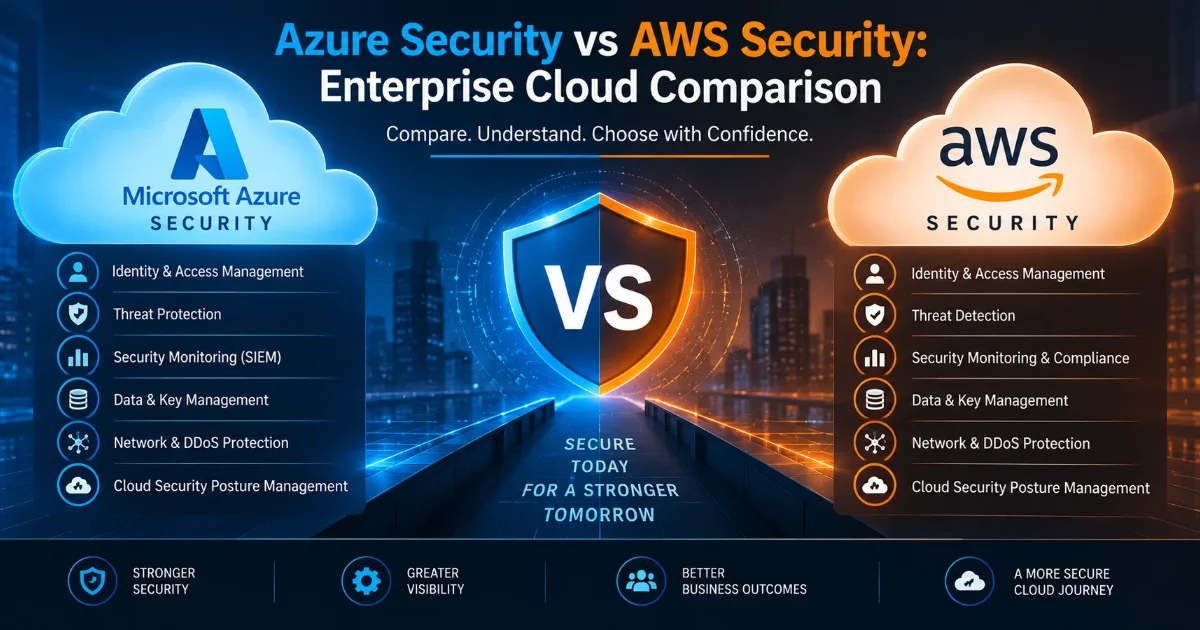
Azure Security vs AWS Security: Enterprise Cloud Comparison
By:
Ganesan D
9 Sep 2026
Category:
Cyber Security
Introduction
Cloud computing has become an essential part of modern business infrastructure, allowing organizations to scale applications, store data, and support remote operations without maintaining all infrastructure on-premises. However, moving workloads to the cloud also introduces security responsibilities that businesses must carefully manage.
Azure Security and AWS Security provide comprehensive security capabilities designed to protect cloud workloads, identities, applications, networks, and data. While both platforms offer strong security controls, their tools, services, and approaches differ. Understanding Azure Security vs AWS Security can help enterprises select the cloud environment that best matches their security, compliance, and operational requirements.
Azure Security
Microsoft Azure provides a broad range of security capabilities across identity, infrastructure, applications, data, and cloud operations.
Key Azure Security Capabilities
- Microsoft Entra ID for identity and access management
- Microsoft Defender for Cloud for cloud security posture management and threat protection
- Azure Firewall for network traffic protection
- Azure Key Vault for protecting keys, secrets, and certificates
- Azure DDoS Protection against distributed denial-of-service attacks
- Microsoft Sentinel for security monitoring and SIEM capabilities
Azure is particularly attractive to organizations already using Microsoft technologies such as Microsoft 365, Windows Server, and other Microsoft security solutions.
AWS Security
Amazon Web Services (AWS) provides security services designed to protect cloud infrastructure, applications, identities, and data.
Key AWS Security Capabilities
- AWS Identity and Access Management (IAM)
- Amazon GuardDuty for threat detection
- AWS Security Hub for centralized security findings
- AWS WAF for web application protection
- AWS Shield for DDoS protection
- AWS Key Management Service (KMS) for encryption key management
- Amazon CloudTrail for activity and API logging
These services enable organizations to implement access controls, monitor cloud activity, detect threats, and protect applications and data across AWS environments.
Azure Security vs AWS Security Comparison
| Feature |
Azure Security |
AWS Security |
| Identity |
Microsoft Entra ID |
AWS IAM |
| Threat Protection |
Microsoft Defender for Cloud |
Amazon GuardDuty |
| SIEM |
Microsoft Sentinel |
Amazon Security Lake / integrations |
| Key Management |
Azure Key Vault |
AWS KMS |
| Web Protection |
Azure WAF |
AWS WAF |
| DDoS Protection |
Azure DDoS Protection |
AWS Shield |
| Activity Logging |
Azure Monitor / Activity Logs |
AWS CloudTrail |
| Security Posture |
Defender for Cloud |
Security Hub and related services |
Both platforms provide strong cloud security capabilities. The right choice depends on the organization's existing technology environment, workloads, compliance requirements, security expertise, and operational preferences.
Shared Responsibility
Both Azure and AWS follow a shared responsibility security model. This means cloud providers are responsible for securing the underlying cloud infrastructure, while customers remain responsible for securing many aspects of their workloads.
Depending on the service being used, customers may be responsible for:
- User identities and permissions
- Application security
- Data protection
- Security configurations
- Operating systems for applicable workloads
- Network access controls
- Compliance requirements
The exact responsibilities vary depending on whether the organization uses infrastructure, platform, or software services. Businesses should understand their responsibilities before deploying workloads to either platform.
Recommendation
There is no universal winner in the Azure Security vs AWS Security comparison. The best platform depends on the organization's existing infrastructure, business requirements, security capabilities, and cloud strategy.
Azure may be a strong choice when:
- The organization already uses Microsoft 365 and Microsoft technologies
- Microsoft Entra ID is central to identity management
- Integration with Microsoft's security ecosystem is important
- The business requires strong hybrid-cloud capabilities
AWS may be a strong choice when:
- The organization already operates extensively on AWS
- It requires a broad selection of cloud-native services
- AWS-native security and monitoring tools fit existing operations
- The business has an established AWS skill set
In both environments, security depends heavily on proper configuration, identity management, monitoring, patching, and ongoing security management.
Conclusion
Both Azure Cloud Security and AWS Cloud Security provide mature capabilities for protecting enterprise cloud environments. Azure offers strong integration with the Microsoft security ecosystem, while AWS provides an extensive collection of cloud-native security services and controls.
Rather than choosing a platform based solely on individual security features, enterprises should evaluate their existing infrastructure, application requirements, compliance obligations, internal expertise, and security operations.
A well-configured cloud environment, supported by strong identity controls, continuous monitoring, data protection, and appropriate security practices, is essential regardless of whether an organization chooses Azure or AWS.