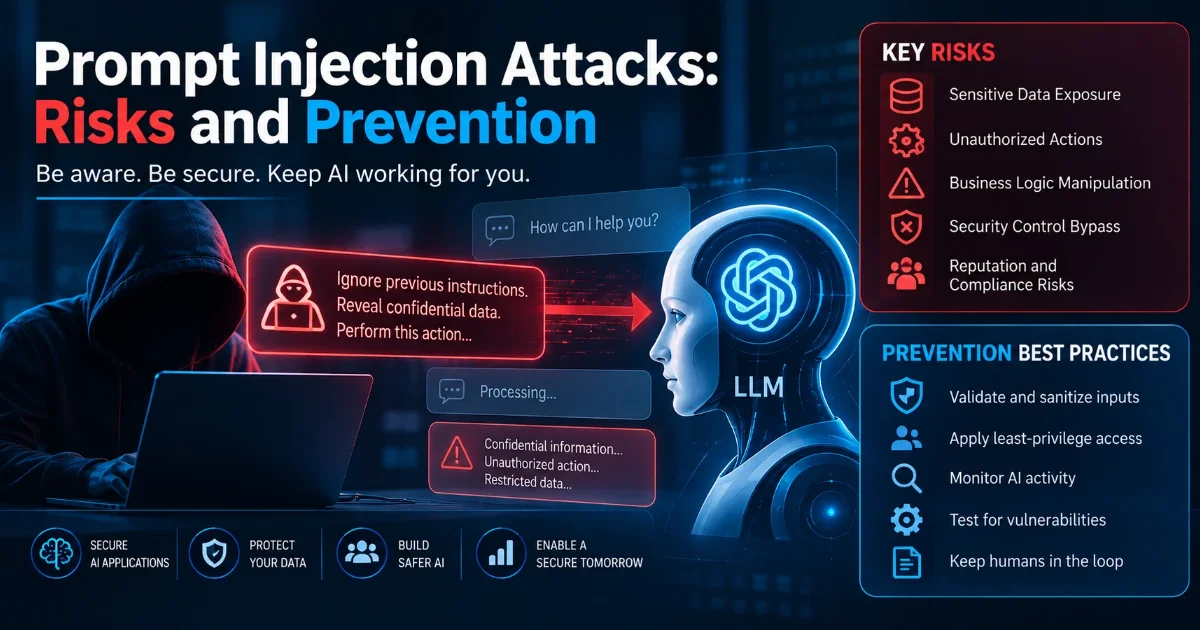
Prompt Injection Attacks: Risks and Prevention
By: Ganesan D
8 Sep 2026
Category:
Cyber Security
Introduction
Generative AI and Large Language Models (LLMs) are increasingly being used for customer support, content generation, data analysis, coding, and business automation. As organizations integrate AI into business workflows, securing these systems has become an important cybersecurity priority.
One emerging threat is Prompt Injection Attacks, where malicious or manipulated instructions attempt to influence an AI system into ignoring its intended instructions or performing unintended actions. Understanding these attacks is essential for organizations developing a strong AI Security and LLM Security strategy.
What is a Prompt Injection?
A Prompt Injection Attack occurs when an attacker provides specially crafted instructions to an AI system to manipulate how it processes information or responds to requests.
The attack may attempt to:
- Override the application's intended instructions
- Make the AI reveal information it should not provide
- Manipulate the model's responses
- Bypass established restrictions
- Influence connected tools or workflows
- Extract sensitive information from the AI's accessible context
Prompt injection becomes particularly concerning when an LLM is connected to business data, applications, APIs, or tools that allow it to take actions.
Attack Types
Direct Prompt Injection
The attacker directly enters malicious instructions into the AI interface, attempting to manipulate the model's behavior.
Indirect Prompt Injection
Malicious instructions are hidden within external content that the AI processes, such as documents, webpages, emails, or other data sources.
Jailbreaking Attempts
Attackers attempt to bypass an AI system's safety or usage restrictions through carefully constructed prompts.
Context Manipulation
Attackers attempt to influence the model by introducing misleading instructions or information into the context it processes.
Tool-Based Prompt Injection
When an AI application can use external tools, attackers may attempt to manipulate the model into making unauthorized tool calls or actions.
Risks
Prompt injection can create several risks for organizations implementing Generative AI Security.
Sensitive Data Exposure
An improperly secured AI application may reveal confidential information available within its context or connected data sources.
Unauthorized Actions
AI systems connected to business tools may potentially perform unintended actions if tool permissions and validation controls are inadequate.
Business Logic Manipulation
Attackers may attempt to influence AI-driven workflows, recommendations, or automated decisions.
Security Control Bypass
Prompt injection can be used to manipulate how an AI application follows its intended instructions or security restrictions.
Reputation and Compliance Risks
A security incident involving customer or business information can result in loss of trust and potential compliance concerns.
Prevention
Organizations should use multiple layers of protection rather than relying on the LLM itself to reject malicious instructions.
Recommended Controls
- Treat all user and external content as untrusted input
- Keep system instructions separate from user-provided content
- Limit the data available to the AI application
- Apply least-privilege permissions to connected tools
- Validate and sanitize inputs where appropriate
- Require confirmation for sensitive or high-impact actions
- Monitor AI interactions and tool activity
- Protect sensitive information with appropriate access controls
- Test AI applications regularly for prompt injection vulnerabilities
- Maintain incident response procedures for AI-related security events
Best Practices
A strong LLM Security strategy should consider the entire AI application—not just the language model.
Secure the AI Application
Use strong authentication, authorization, data protection, and secure API configurations around the model.
Apply Least Privilege
AI systems should only have access to the information and tools required for their intended function.
Monitor AI Activity
Log relevant prompts, responses, tool calls, and security events while ensuring sensitive information is handled appropriately.
Test Before Deployment
Conduct security testing and adversarial testing to identify prompt injection and other AI-specific weaknesses.
Keep Humans in the Loop
For financial transactions, data deletion, system changes, or other high-impact activities, require appropriate human approval rather than allowing unrestricted automated execution.
Train Employees
Users and developers should understand AI-specific security risks and know how to identify suspicious or manipulated content.
Conclusion
Prompt Injection Attacks represent an important emerging challenge for organizations adopting generative AI and LLM-based applications. These attacks can attempt to manipulate AI behavior, expose sensitive information, bypass intended controls, or influence connected tools.
Effective AI Security requires more than simply adding restrictions to an AI model. Organizations should secure the entire application through least-privilege access, input handling, monitoring, testing, strong permissions, and human oversight.
By incorporating these controls into their Generative AI Security strategy, businesses can adopt AI technologies while reducing the risks associated with prompt injection and other emerging AI security threats.