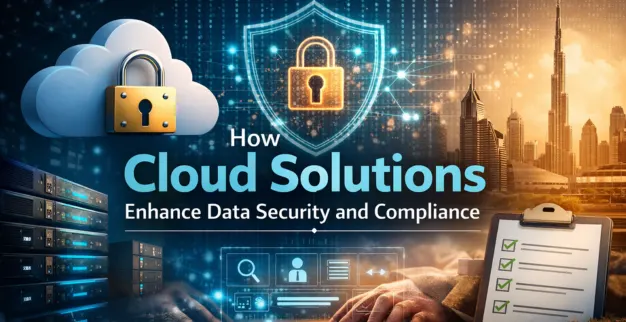
How Cloud Solutions Enhance Data Security and Compliance
17 Feb 2026
Category: Cloud Solutions
Enterprises in the UAE are leveraging cloud solutions to an increasing extent to safeguard confidential data and comply with the regulations. The continuous increase of cyber attacks and the imposition of data privacy laws require that an organizations IT setup is secure and compliant with the regulations. Cutting, edge cloud technologies offer sophisticated security features, safe cloud data storage as well as efficient compliance management. This guide describes how cloud computing helps increase data security and eases compliance.
1. Advanced Cloud Security Infrastructure
One of the greatest benefits of cloud solutions is enterprise, grade cloud security that is inherent to the infrastructure. Most cloud providers put a lot of money into security technologies that normal businesses can hardly afford on their own.
- Complete data encryption (both when data is moving and when it is stored)
- Several nested firewalls and intrusion detection systems
- Security monitoring and threat detection round the clock
- Advanced identity and access management controls
Such hidden security features drastically lessen the chances of data leaks and unauthorized access.
2. Secure Cloud Data Storage and Backup
Reliable cloud data storage plays an important role in business continuity not only on regular days but also in times of unforeseen events. Cloud technology facilitates the setting of schedules for automatic backups. Besides, through data replication across a network of multiple locations, the cloud storage is capable of providing higher levels of security.
- Automation of data backup and disaster recovery
- Duplicated storage over multiple geographically distributed data centers
- Rapid data recovery at the time of system failure
- Security from hardware damage and ransomware attacks
With this kind of redundancy, operations are guaranteed to be uninterrupted and the time for which they are down will be very minimal.
3. Regulatory Compliance and Governance Support
For companies that handle financial, healthcare, or customer data, compliance is one of the biggest concerns. Cloud solution can make compliance management easier through built, in governance tools.
- Complys with international and regional laws.
- Log detailed audit trails and have reporting mechanisms.
- Classify data and manage retention.
- Secure and manage access control compliant with industry standard.
It is quite common for cloud providers to have certifications, which can help businesses meet their legal and regulatory requirements in a more efficient way.
4 . On, demand security at scale with cloud technology
Today, companies with the help of cloud technology are able to easily increase the level of security as they continue growing. If the company is either developing its activities or gets a larger amount of data, then its security measures are also scaled up accordingly.
- Security configurations flexible to any business
- Automated patch management and updates
- Security monitoring through central control panels
- Scalability without hardware investment and at a low cost
Such scalability is the guarantee of the business being protected over time without the need for complicated infrastructure upgrades.
5. Reduced Internal Security Burden
Traditional on, premises systems need committed IT staff to be constantly watchful, keep them up to date with patches, and handle security threats. Cloud solutions alleviate this problem by offering managed security services.
- Cloud security professionals continuously monitor.
- Software updates are automatically installed.
- Local maintenance is lessened.
- There is a quicker reaction time to new cyber threats.
Businesses get an opportunity to concentrate on expansion instead of worrying about the management of their infrastructure.
6. Enhanced Access Control and Data Visibility
Cloud platforms offer detailed visibility into the usage and access patterns of data. Companies are able to identify the users who had access to certain files along with the time of access.
- Role-based access control
- Multi-factor authentication
- Real-time security alerts
- Secure remote access for hybrid work environments
These capabilities help increase responsibility and minimize the possibilities of insider threats.
Conclusion
Implementing cloud solutions nowadays is much more than just a matter of convenience, it is a deliberate decision to improve data security and ensure compliance with the law. By adopting state, of, the, art cloud security frameworks, trustworthy cloud data storage, and scalable cloud technology, companies will be able to protect sensitive data as well as satisfy regulatory requirements.
At Agan Cybersecurity LLC we offer secure, compliant, and cost, effective cloud solutions customized to your business requirements.