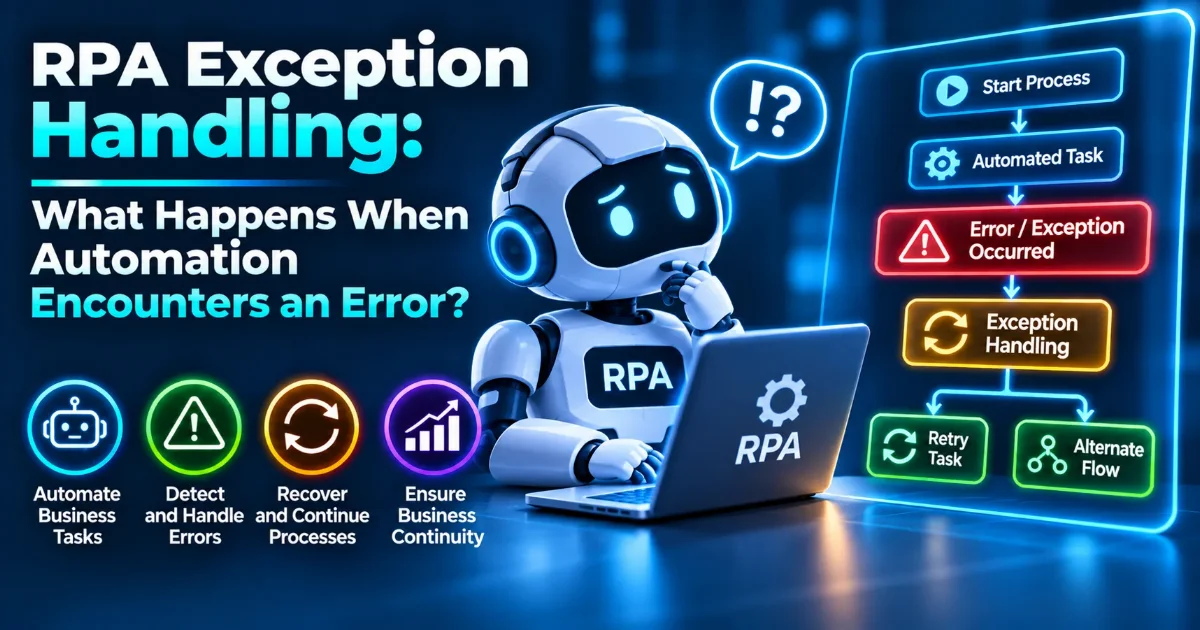
RPA Exception Handling: What Happens When Automation Encounters an Error?
By: Ganesan D
17 Nov 2026
Category:
Custom
Introduction
Robotic Process Automation (RPA) streamlines repetitive processes within an organisation such as invoice processing, data entry, report creation and updating of customer information. These processes may not always run smoothly due to missing data, application errors, unexpected data and network issues.
RPA Exception Handling helps automate processes by identifying errors, unexpected scenarios and allowing a safe recovery. Having an effective exception handling system within RPA improves the reliability of your automation, reducing the need for constant human monitoring.
What Is RPA Exception Handling?
Exception handling in RPA is the identification of errors and resolving them when they occur during a software bot performing an automated task.
If the bot is designed correctly, then instead of halting, it will utilise pre-defined rules to resolve the issue. This can include re-attempting the task, logging the error, skipping the transaction or requesting human assistance.
Using a systematic method for exception handling in robotic process automation ensures businesses can run their processes consistently and prevent any issues from affecting other systems.
Common Errors in RPA Automation
When using RPA bots to interact with applications, databases, files and websites, any changes or issues can occur that will impact their automation. Common issues that can occur are:
-
Application Issues:
The application crashes, cannot be accessed or behaves unexpectedly.
-
Network Issues:
Connectivity issues occur temporarily.
-
Data Issues:
Data is missing, incorrect or in the wrong format.
-
UI Issues:
The website or application has changed, meaning the bot cannot find the correct buttons or fields.
-
Authentication Issues:
Passwords have expired, access is denied or sessions have timed out.
-
Business Rules:
The transaction does not meet defined rules, such as an invoice exceeding the approval limit.
It is very important to understand why the error occurred so that the correct fix can be applied.
Types of Exceptions in RPA
There are typically two types of RPA exceptions:
1. Business Exceptions
These relate to business processes where a transaction does not meet business rules. This could be something like an invoice having an invalid supplier number or requiring further approval.
These typically need to be validated, corrected or reviewed by an authorised employee.
2. System Exceptions
These relate to technical issues such as application errors, network outages, database connection errors or services not being available.
Depending on the cause of these exceptions, the bot may attempt to resolve them by re-trying the process, restarting an element or raising them to technical support.
Knowing the differences between them will help automation teams avoid automatically assuming that every error they encounter is a technical error.
Error Detection and Logging
Good error handling in RPA starts by quickly identifying any issues. Your bots should have validation, exception detection and logging built in. When there is an error, the system should log:
-
The time and date of failure.
-
Transaction or process reference.
-
Error message and type of exception.
-
Workflow step where the error occurred.
-
What was done to resolve the issue.
-
The outcome of the transaction.
This will help your technical team identify recurring issues, understand the root cause and improve your automation. You should avoid logging any sensitive data.
Retry Mechanisms in RPA
Some automation errors will be temporary and can be resolved by attempting the activity again.
Bots can be set up to repeat failed activities based on specific criteria. If a payment application is temporarily unavailable, the bot can wait and try again. A good retry strategy should:
-
Limit the number of attempts.
-
Set appropriate time delays.
-
Define clear stopping criteria.
-
Avoid duplicate transactions.
-
Escalate if the issue cannot be resolved.
It is important to be cautious with retries on activities involving payments, submissions or transactions, as repeated attempts could result in duplication.
When Is Human Intervention Required?
Some exceptions will need manual intervention. This may be required because of:
-
Unclear or conflicting information within documents.
-
Transaction amounts above pre-defined approval thresholds.
-
Business rules requiring manager approval.
-
Technical errors that continually occur and cannot be recovered from.
-
Situations where there is no safe way to determine what to do next.
When designing your automation workflow, you should ensure that the correct employee is alerted to the issue with the relevant exception details. The workflow should also be able to continue once the exception has been dealt with.
Improving Bot Reliability
In order to make your automation more reliable, you should:
-
Ensure that the input data is validated.
-
Create specific rules for handling business exceptions and system exceptions.
-
Implement comprehensive error logging.
-
Implement managed retry processes.
-
Use monitoring to understand how your bots are performing and what failures are occurring.
-
Test scenarios involving unexpected occurrences.
-
Update your automation rules as applications change.
Regular monitoring and management will ensure that small issues do not develop into ongoing problems.
Frequently Asked Questions
1. Why Is Exception Handling Important in RPA?
Exception handling helps bots cope with unexpected errors, reduces disruption and enables reliable automation.
2. Can an RPA Bot Recover Automatically from Errors?
Yes. Certain actions can be retried and predefined fallback processes can be put in place. However, some complex or business-related exceptions will require manual intervention.
3. What Is the Difference Between a Business Exception and a System Exception?
Business exceptions occur when a transaction does not match a business rule. System exceptions occur due to technical failures such as application errors, network problems or database connection issues.
4. How Can Businesses Reduce RPA Failures?
Businesses can reduce automation failures by ensuring data is validated, exceptions are properly handled, workflows are tested and automation systems are monitored and maintained regularly.
Conclusion
Exception handling using RPA is important to ensure automation processes are reliable. By identifying issues, maintaining logs, limiting retries and involving staff when necessary, businesses can ensure their bots operate reliably.
We at Agan Cyber Security LLC can help your business explore secure technologies to improve operational reliability. Get in touch with our team to discuss the technologies your business needs to improve its processes in Dubai and throughout the UAE.