Process Mining: Discovering Which Business Tasks Should Be Automated
By: Ganesan D
16 Nov 2026
Category:
Custom
Introduction
Many businesses will look to automate processes to reduce manual effort and improve productivity. However, without understanding how your processes operate, automation could simply speed up problems caused by inefficient processes. Understanding how your business processes operate is key to ensuring that automation is implemented effectively.
Using process mining, businesses can understand their operational data and spot inefficiencies in their workflows. By combining this with RPA, organisations can make informed decisions on where to implement automation to provide the most value.
Using process mining can help companies looking into RPA in Dubai create effective automation strategies by providing data-driven insights.
What Is Process Mining?
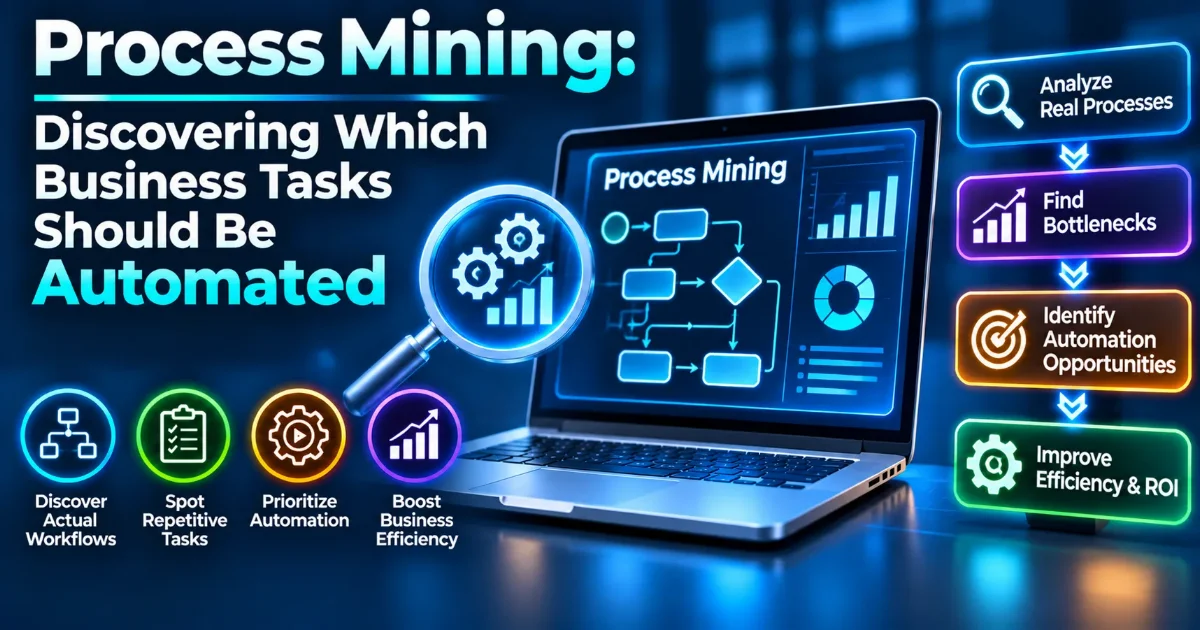
Process mining is a data analysis technology that looks at events generated by business applications like ERP, CRM systems, accounting and supply chain systems. It helps businesses understand their real processes by looking at how activities have been performed compared to how they should have been performed.
Instead of asking employees questions, as traditional process mapping does, it uses actual data from business systems to show how long tasks take and how they are being completed, including any issues.
The data helps organisations understand how well their processes are performing so they know what to automate.
How Are Business Processes Analysed?
Process mining will typically look at event logs that contain data such as the activity name, timestamp and case ID. A typical invoice processing workflow may consist of:
-
Receipt of invoice from supplier.
-
Entering invoice details into the accounting system.
-
Verification of information against the purchase order.
-
Submitting the invoice for approval.
-
Processing payment.
-
Recording the transaction.
This will help organisations understand where there are repetitive manual processes, unnecessary approvals, delays and deviations within their processes.
Workflow Mapping: Understanding Actual Business Operations
Workflow mapping provides a visual representation of how work flows through people, departments and systems.
Process mining can help highlight discrepancies between what is documented and how staff are actually performing tasks. For example, invoices may be documented as requiring two approvals but often need further approvals due to missing information.
This will allow management to identify redundant processes, increase accountability and create standardised processes before looking at automation.
Identifying Process Bottlenecks
A bottleneck is a specific activity in a business that causes delays. These delays may create additional costs for the organisation. Through process mining, you can identify common bottlenecks that you may be facing, such as:
-
Manual data input and repetitive data entry.
-
Delays in invoice and purchase approvals.
-
Duplicate verification activities.
-
Frequent mistakes requiring corrections.
-
Tasks being repeatedly transferred between departments.
-
Missing information and incomplete documentation.
By reviewing how long processes take and identifying frequently repeated activities, you can identify key areas to focus on that will have the biggest operational impact.
Discovering Automation Opportunities with RPA
Once inefficient processes have been identified, businesses will know which processes could be automated using Robotic Process Automation (RPA).
Robotic Process Automation is a form of automation that uses software robots to carry out repetitive and rule-based processes. This can be used in many areas, including:
-
Entering and processing invoice data.
-
Onboarding employee documentation.
-
Transferring data between ERP and CRM systems.
-
Creating reports and regular updates.
-
Processing purchase orders.
-
Validating customer information.
Process mining can help highlight the most suitable processes to automate based on factors such as how often they occur, processing time, error rates and impact on the business.
Processes that require complex decision-making or frequently involve exceptions may require process improvements or manual intervention rather than full automation.
Improving Process Efficiency Through Business Automation
Implementing process mining alongside RPA allows companies to turn insights into tangible improvements.
Insights gained can be used to streamline processes, automate appropriate functions and monitor performance.
For companies looking to implement RPA solutions in Dubai or robotic process automation in Dubai, this approach can allow for targeted investment in automation.
By effectively automating business processes in the UAE, organisations can reduce time spent on repetitive administrative tasks, ensure consistent processes and enable staff to focus on more valuable activities.
Frequently Asked Questions
1. What Is the Difference Between Process Mining and RPA?
Process mining is an analysis tool that helps uncover inefficiencies and automation opportunities within your business processes. RPA, on the other hand, uses software bots to carry out repetitive tasks.
2. What Processes Can I Automate Using RPA?
Processes that are repetitive, high-volume and rule-based are suitable for RPA. Common examples include invoice processing, data entry, report creation and information sharing.
3. Which Business Processes Are Suitable for RPA?
Repetitive, high-volume and rule-based activities such as invoice processing, data entry, report generation and information transfer are common candidates for RPA.
4. Is Process Mining Useful for SMEs?
Yes. Small and medium-sized enterprises can benefit from process mining to understand inefficiencies in their operations. They can then focus on areas where automation can be introduced in line with their resources and business requirements.
Conclusion
Process mining is an approach that enables businesses to understand how their processes work. This helps identify bottlenecks, process flows and repetitive tasks so organisations can make more informed decisions about which processes to automate using RPA.
Agan Cyber Security LLC can help your business explore its technological options. We can discuss your automation needs to ensure you have the right solutions implemented for your business in Dubai and throughout the UAE.