In-House Security Team vs Managed Security Services
20 August 2026
Introduction
Cyber threats are becoming more frequent, sophisticated, and difficult for businesses to manage internally. Organizations need continuous security monitoring, threat detection, incident response, and cybersecurity expertise to protect critical systems and data.
Businesses generally have two options: build an in-house security team or use Managed Security Services from an external cybersecurity provider. Cyber Security Outsourcing can provide access to specialized professionals and technologies without the cost and complexity of maintaining a large internal security operation.
In-House Team
An in-house security team consists of cybersecurity professionals employed directly by the organization. The team manages security operations, technologies, policies, and incident response internally.
Key Responsibilities
- Security monitoring and alert investigation
- Vulnerability management
- Incident response
- Security policy management
- Compliance support
- Threat detection and analysis
- Security tool administration
Advantages
- Direct control over security operations
- Strong understanding of internal systems
- Immediate communication with business teams
- Greater control over security processes
Challenges
Building an effective internal team can be expensive and time-consuming.
Common challenges include:
- Recruiting skilled cybersecurity professionals
- Employee retention and skills shortages
- 24/7 monitoring requirements
- Security technology and infrastructure costs
- Training and certification expenses
- Managing staff coverage during nights, weekends, and holidays
For smaller organizations, maintaining continuous security operations internally can be particularly challenging.
Managed Services
Managed Security Services allow businesses to outsource some or all cybersecurity operations to specialized security providers.
A provider can manage security monitoring, threat detection, vulnerability management, incident response, and other security functions.
Managed SOC Services
Managed SOC Services provide continuous security monitoring through a Security Operations Center. Security analysts monitor alerts, investigate suspicious activity, and help organizations respond to security incidents.
MDR Services
MDR Services (Managed Detection and Response) combine advanced security technologies with security expertise to identify, investigate, and respond to threats.
Managed services can provide access to experienced security professionals without requiring the organization to build a complete internal security operation.
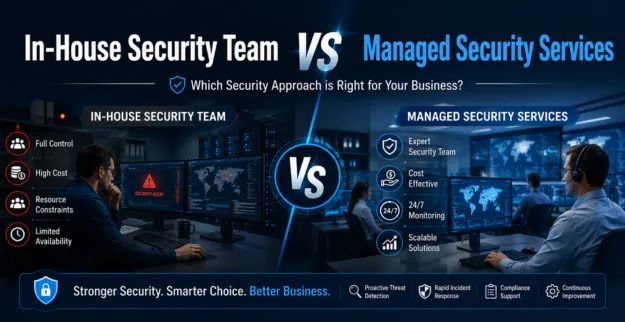
Comparison
| Feature |
In-House Security Team |
Managed Security Services |
| Security Staff |
Direct employees |
External security specialists |
| Monitoring |
Depends on internal coverage |
Often 24/7 |
| Expertise |
Requires internal recruitment |
Access to specialized expertise |
| Technology Costs |
Managed internally |
Shared through service provider |
| Scalability |
Requires additional hiring |
Easier to scale |
| Incident Response |
Internal team |
Managed or supported by provider |
| Availability |
Limited by staffing |
Continuous monitoring options |
| Management |
Fully internal |
Shared or outsourced |
The right option depends on the organization's size, risk profile, internal expertise, and security requirements.
Cost Analysis
The cost of an in-house security team extends beyond employee salaries.
Organizations may need to budget for:
- Cybersecurity professionals and analysts
- Recruitment and training
- Security monitoring platforms
- SIEM and endpoint security solutions
- Infrastructure and licensing
- 24/7 staffing requirements
- Professional certifications
With Cyber Security Outsourcing, businesses typically pay for the services they require without carrying the full cost of building and maintaining a large security operation.
Managed services can therefore provide predictable costs and access to specialist expertise, although pricing varies depending on the scope, technology, number of users or assets, and service level.
Recommendation
An in-house security team may be suitable for organizations with:
- Large security budgets
- Dedicated cybersecurity leadership
- Complex internal security requirements
- Existing security expertise
- Resources to provide continuous monitoring
Managed Security Services may be more suitable for businesses that:
- Lack specialized cybersecurity expertise
- Need 24/7 monitoring
- Want to reduce security staffing requirements
- Need access to advanced security technologies
- Want scalable cybersecurity support
Many organizations choose a hybrid approach, where an internal IT or security team works alongside a managed provider for specialized monitoring, threat detection, or incident response.
Conclusion
Choosing between an in-house security team and Managed Security Services is an important strategic decision. While an internal team provides direct control and deep knowledge of the organization's environment, building and maintaining a fully staffed security operation can require significant resources.
FAQ
1. Is an in-house security team better than managed security services?
Not necessarily. The best option depends on the organization's size, budget, security maturity, risk profile, and available expertise.
2. What are Managed Security Services?
Managed Security Services are outsourced cybersecurity services where a specialized provider manages selected security functions such as monitoring, threat detection, vulnerability management, and incident response.
3. What are Managed SOC Services?
Managed SOC Services provide continuous security monitoring and analysis through an external Security Operations Center, often with 24/7 threat detection and response capabilities.