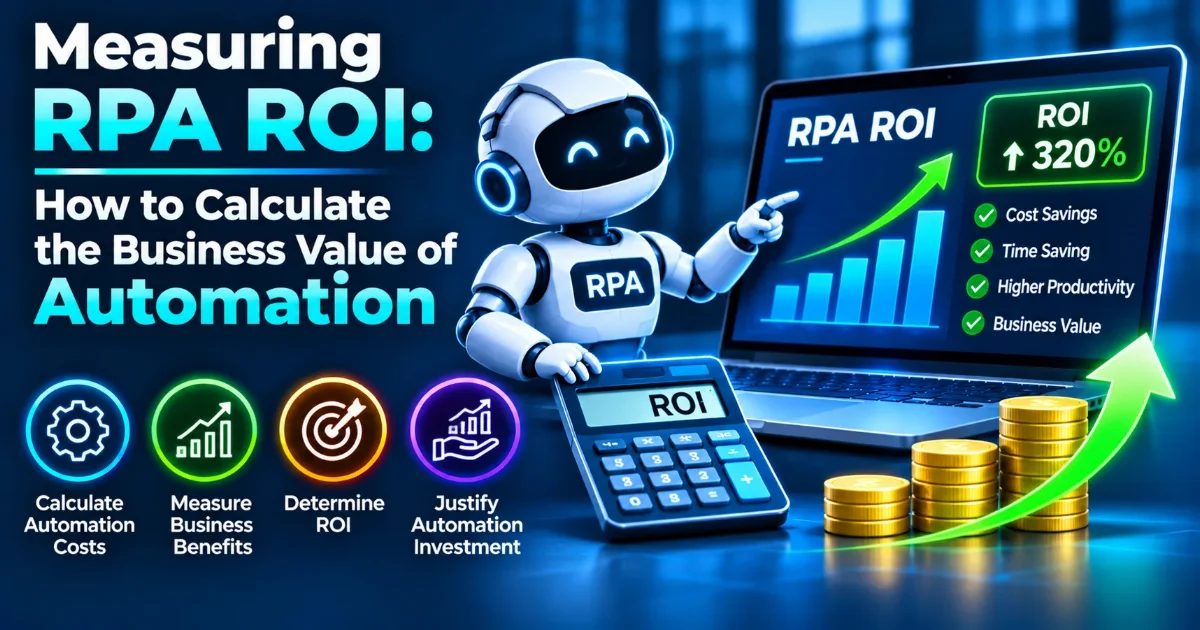
Measuring RPA ROI: How to Calculate the Business Value of Automation
By: Ganesan D
18 Nov 2026
Category:
Custom
Introduction
Robotic Process Automation (RPA) can help your business automate repetitive processes like invoice processing, data entry, creating reports and updating customer records. Understanding whether you are gaining a return on investment will enable your business to identify whether there are real financial gains to be achieved.
Understanding how to calculate RPA ROI (Return on Investment) enables organisations to measure the true value of automation. When you know the costs involved in implementing automation, you can make informed decisions when looking to scale up your automation.
What Is RPA ROI?
RPA ROI measures how much an organisation gains from implementing Robotic Process Automation.
This helps an organisation understand whether it is getting value by reducing costs and freeing up employees' time.
A proper Return on Investment analysis should take into account both quantifiable savings and qualitative benefits such as increased speed, accuracy and resource utilisation.
Understanding Automation Costs
In order to calculate your ROI, you need to determine all the costs associated with RPA implementation. These can include:
-
Software Licensing:
RPA platforms, bots and subscription fees.
-
Implementation:
Workflow design, development and implementation costs.
-
Server Infrastructure:
Servers and cloud-based infrastructure.
-
Integration:
Integrating bots with ERP, CRM, accounting and other business applications.
-
Training:
Training staff to manage and monitor automation.
-
Maintenance:
Monitoring, troubleshooting, upgrading and improving bots.
Taking into account both one-time and ongoing costs will give you a more realistic view of your total investment when implementing automation.
Measuring Time and Labour Savings
One of the most obvious advantages of using RPA is the time saved through automation.
For example, let's say a business processes 1,000 invoices per month. If it takes 5 minutes to process each invoice manually, then the business spends approximately 83.3 working hours each month on this task.
By automating the process, the average processing time could be reduced to just 1 minute per invoice. This would reduce the processing time to approximately 16.7 hours, saving 66.6 working hours each month.
You can calculate the potential financial value of these savings by multiplying the number of hours saved by the relevant hourly employee cost. However, unless these time savings reduce expenses or create additional productive capacity, they will not necessarily translate into direct financial savings.
Productivity Improvements and Business Value
Automation can improve business processes in several ways:
-
Speed:
Bots can perform repetitive tasks quickly and consistently.
-
Accuracy:
Automated processes can reduce data entry errors and improve consistency.
-
Scalability:
Businesses can handle greater transaction volumes without proportionally increasing manual effort.
-
Increased Productivity:
Employees can focus on customer service, analysis and other higher-value activities.
-
Consistency:
Standardised processes can improve operational control and reliability.
These improvements contribute to the overall business value of implementing RPA.
How to Calculate RPA ROI
A commonly used formula for calculating RPA Return on Investment is:
RPA ROI (%) = [(Benefits - Costs) / Costs] x 100
Let's consider an example to understand how this formula works.
A company invests in an RPA solution with the following annual costs and benefits:
| Item |
Annual Amount |
| Software and implementation costs |
AED 12,000 |
| Maintenance and support costs |
AED 3,000 |
| Training and infrastructure costs |
AED 5,000 |
| Total Investment |
AED 20,000 |
| Total Benefits |
AED 35,000 |
RPA ROI Calculation Example
Using the formula above:
RPA ROI = [(35,000 - 20,000) / 20,000] x 100
RPA ROI = 75%
There would be an estimated net benefit of AED 15,000 over the first year of investment, assuming the AED 35,000 in benefits are quantifiable, realised within the same period and not counted elsewhere.
Measuring Long-Term Benefits
It is important not to assess RPA only during the initial deployment phase. Regularly reviewing automation performance using measurable metrics will help organisations understand its long-term value.
Some important metrics to monitor include:
- Hours saved through automation.
- Cost per transaction.
- Number of transactions automated.
- Process error rate.
- Average processing time.
- Bot uptime and downtime.
- Maintenance and support costs.
By monitoring these performance indicators, organisations can identify underperforming processes, improve their automation and decide whether additional processes should be automated.
Common RPA ROI Calculation Mistakes
Businesses may overestimate the benefits of automation if they make mistakes during ROI calculations. Some common mistakes include:
-
Not accounting for maintenance, licensing or infrastructure costs.
-
Assuming every hour saved automatically translates into financial savings.
-
Ignoring exceptions and manual intervention requirements.
-
Calculating benefits without establishing a baseline for comparison.
-
Double-counting productivity improvements and financial benefits.
-
Failing to recognise process changes and employee training requirements.
By using realistic assumptions and regularly reviewing actual performance, businesses can achieve a more accurate understanding of their RPA ROI.
Frequently Asked Questions
1. How Long Does It Take to Achieve RPA ROI?
It depends on transaction volume, implementation costs, process complexity and the savings achieved. Some automation projects may recover their investment within a few months, while others may take longer.
2. What Is the Most Important Factor in RPA ROI?
Key factors include the overall cost of automation, the measurable benefits gained and the suitability of the processes being automated.
3. Can Small Businesses Benefit from RPA?
Yes. Small businesses can automate repetitive tasks to reduce administrative work, improve efficiency and allow employees to focus on more important business activities.
4. Should RPA ROI Include Non-Financial Benefits?
Yes. Businesses should also track improvements in accuracy, scalability, employee productivity and customer experience, even when these benefits cannot be directly measured in financial terms.
Conclusion
Calculating RPA ROI helps businesses understand how effective their investment in automation is. It takes into account implementation costs, employee time savings, increased productivity and long-term performance.
Agan Cyber Security LLC can help your business explore technology solutions that improve operational efficiency. Talk to our team about your automation requirements and discover how you can improve your business processes in Dubai and throughout the UAE.