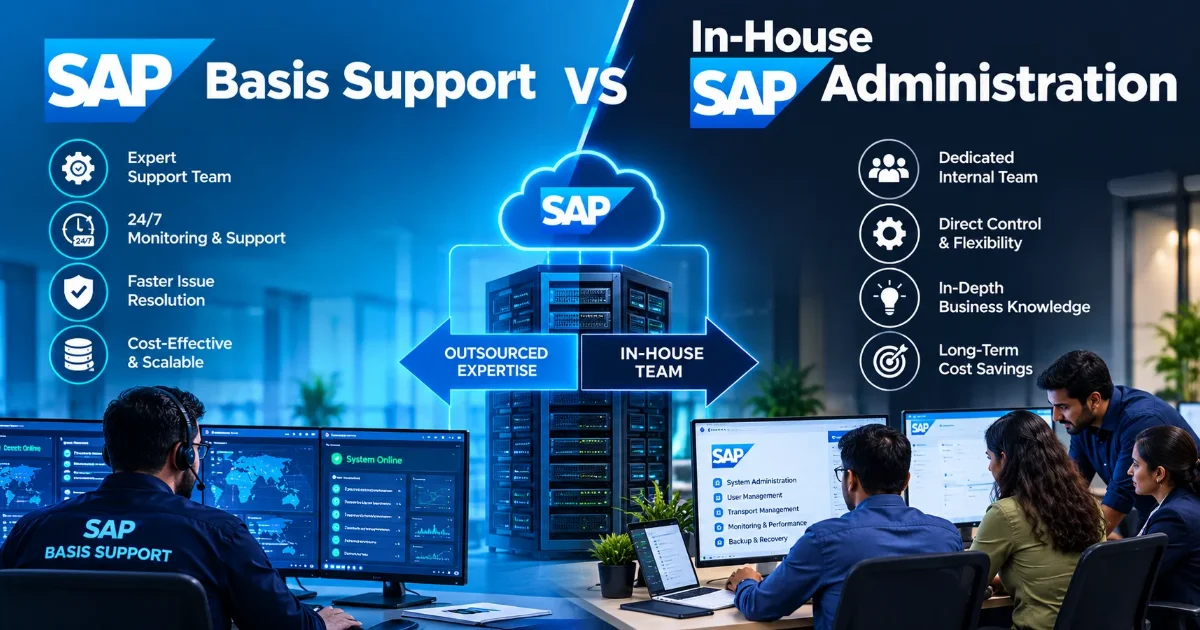
SAP Basis Support vs In-House SAP Administration
By:
Ganesan D
9 Oct 2026
Category:
IT Infrastructure
Introduction
SAP systems are critical to many businesses for managing finance,
operations, sales, supply chain, and other essential processes.
Maintaining these systems requires continuous administration,
monitoring, troubleshooting, and performance management.
Businesses can either build an internal SAP Basis Team or use
external SAP Basis Support Services. Understanding the differences
can help organizations choose the right support model based on
their technical requirements, resources, and budget.
SAP Basis Responsibilities
SAP Basis is responsible for the technical administration and
smooth operation of SAP environments.
Typical responsibilities include:
- SAP system monitoring and administration
- User and authorization management
- Performance monitoring
- System configuration
- Database and system health checks
- SAP updates and patches
- Backup and recovery coordination
- Troubleshooting system issues
- Transport management
- System availability and maintenance
A reliable Basis function helps ensure that SAP systems remain
stable, secure, and available to business users.
Outsourced SAP Basis Support
With outsourced SAP Basis Support, businesses rely on an external
team or service provider to manage selected or all Basis activities.
External Basis Support Services may include:
- 24/7 or scheduled system monitoring
- Performance management
- Incident troubleshooting
- Patch and upgrade support
- Backup monitoring
- Technical maintenance
- Remote administration
- Escalation and issue resolution
This approach can provide access to experienced SAP professionals
without requiring the business to maintain a large internal team.
In-House SAP Administration
An in-house SAP Basis Team consists of employees dedicated to
managing the organization's SAP environment.
This model provides direct control over system administration and
allows the team to develop detailed knowledge of the organization's
specific SAP landscape.
However, businesses need to consider recruitment, training,
salaries, shift coverage, leave management, and ongoing
professional development.
Monitoring and Maintenance
Both models can support essential SAP monitoring and maintenance
activities.
An internal team may provide immediate access to administrators,
while an outsourced provider may offer broader expertise and
extended support hours.
The right choice depends on system complexity, business
requirements, response-time expectations, and the availability
of internal technical resources.
Resource Considerations
In-House Administration
Advantages:
- Direct control over SAP administration
- Strong knowledge of internal systems
- Immediate communication with business teams
Challenges:
- Higher staffing requirements
- Recruitment and training costs
- Limited coverage if the team is small
- Dependence on individual specialists
Outsourced SAP Basis Support
Advantages:
- Access to specialized SAP expertise
- Flexible support options
- Reduced internal staffing requirements
- Potentially broader support coverage
Challenges:
- Dependence on the service provider
- Requires clear SLAs and communication processes
- External teams need sufficient knowledge of the business environment
SAP Basis Support vs In-House SAP Administration:
Key Differences
| Factor |
Outsourced SAP Basis Support |
In-House SAP Administration |
| Team Structure |
External service provider |
Internal employees |
| Control |
Managed through agreed service scope and SLAs |
Direct organizational control |
| Expertise |
Access to external specialists, depending on the provider |
Based on internal team skills and experience |
| Staffing |
Lower direct internal staffing requirements |
Requires recruitment and staff management |
| Support Coverage |
May offer extended or 24/7 coverage |
Depends on internal team size and shift arrangements |
| Business Knowledge |
Developed through onboarding and ongoing collaboration |
Builds through direct internal involvement |
| Best For |
Businesses seeking external expertise and flexible support |
Businesses requiring direct control and dedicated internal resources |
Which Support Model Should You Choose?
Businesses with complex SAP environments and sufficient internal
expertise may prefer an in-house SAP Basis Team.
Organizations with limited technical resources, growing SAP
environments, or a need for extended support may benefit from
SAP Basis Support Services.
A hybrid approach is also possible, where an internal team manages
strategic activities while an external provider handles monitoring,
troubleshooting, or specialized support.
Conclusion
Choosing between SAP Basis Support and in-house SAP administration
depends on the organization's SAP environment, technical expertise,
budget, availability requirements, and support expectations.
Whether managed internally or through Basis Support Services,
regular monitoring, maintenance, security updates, performance
management, and timely troubleshooting are essential for reliable
SAP operations.