SAST vs DAST vs Black Box Testing: Which is Best for Your Business?
25 Apr 2026
Category: Cyber Security
Modern applications face constant cyber threats, making application security testing a critical part of software development. Businesses often struggle to choose between SAST testing, DAST testing, and black box testing.
Each method has its strengths, and selecting the right one depends on your security goals, development stage, and risk profile. This guide will help you understand the differences and choose the best approach.
Comparison of Testing Methods
Understanding how these application security testing methods work is the first step.
SAST Testing (Static Application Security Testing)
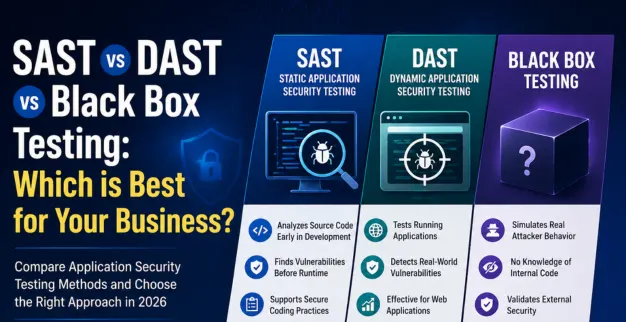
SAST testing analyzes source code, bytecode, or binaries without executing the application. It helps identify vulnerabilities early in the development phase.
DAST Testing (Dynamic Application Security Testing)
DAST testing evaluates applications in a running state. It simulates real-world attacks to find vulnerabilities in live environments.
Black Box Testing
Black box testing focuses on testing the application from an external perspective without knowledge of the internal code. It mimics how an attacker interacts with the system.
Each method plays a unique role in application security testing.
Pros & Cons
SAST Testing – Pros:
Detects vulnerabilities early in development
Provides detailed insights into code-level issues
Supports secure coding practices
SAST Testing – Cons:
May produce false positives
Does not detect runtime issues
DAST Testing – Pros:
Identifies real-world vulnerabilities in live systems
No access to source code required
Effective for web applications
DAST Testing – Cons:
Performed later in the development cycle
Limited visibility into code-level issues
Black Box Testing – Pros:
Simulates real attacker behavior
No prior system knowledge required
Useful for external security validation
Black Box Testing – Cons:
Limited coverage of internal vulnerabilities
Can miss hidden logic flaws
Each approach complements the others in a complete application security testing strategy.
When to Use Each Method
Choosing between SAST testing, DAST testing, and black box testing depends on your needs:
Use SAST testing during the development phase to catch vulnerabilities early
Use DAST testing after deployment to identify runtime issues
Use black box testing to simulate real-world attack scenarios and validate external security
Combining these methods ensures comprehensive application security testing.
Recommendations
The best approach is not choosing one method—but integrating all three into your security strategy.
Recommended Approach:
Start with SAST testing for early detection
Add DAST testing for runtime validation
Use black box testing for real-world attack simulation
Integrate all methods into a continuous testing pipeline
This layered approach provides stronger protection and reduces security risks.
Conclusion
No single method is enough to secure modern applications. SAST testing, DAST testing, and black box testing each play a vital role in application security testing.
By combining these approaches, businesses can identify vulnerabilities at every stage and build a more secure application environment.
FAQ
1. What is SAST testing?
It is a static analysis method that identifies vulnerabilities in source code.
2. What is DAST testing?
It is a dynamic testing method that evaluates applications in a running state.
3. What is black box testing?
It tests applications externally without knowledge of internal code.
4. Which testing method is best?
A combination of all three provides the best security coverage.
5. Why is application security testing important?
It helps identify and fix vulnerabilities before attackers can exploit them.