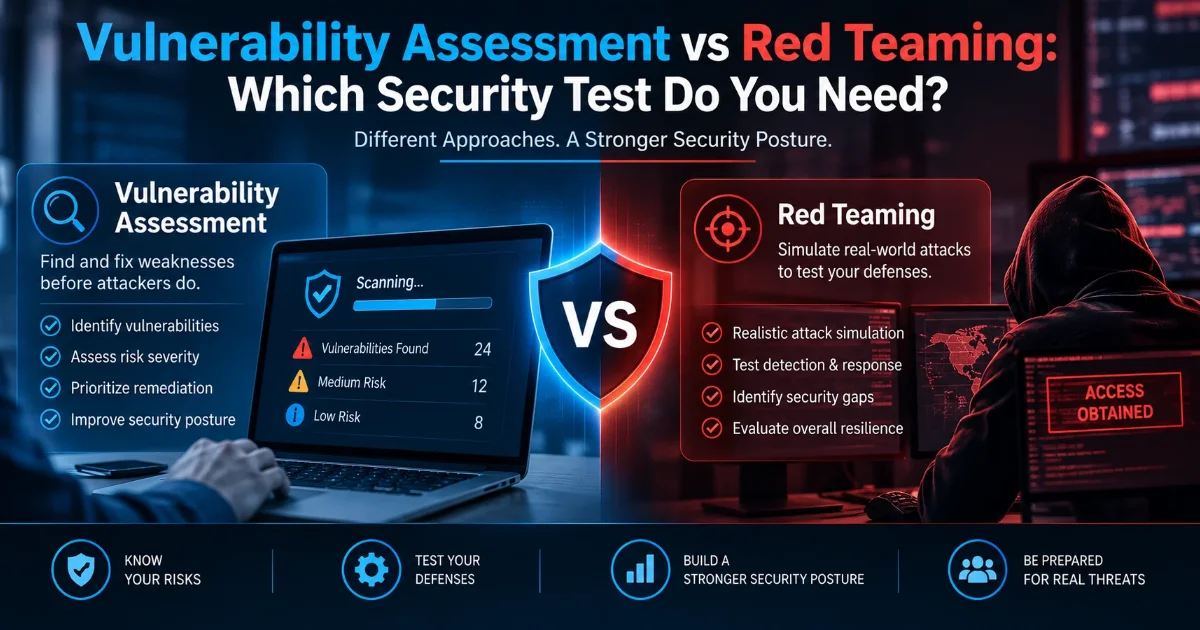
Vulnerability Assessment vs Red Teaming: Which Security Test Do You Need?
By:
Ganesan D
10 Sep 2026
Category:
Cyber Security
Introduction
Cybersecurity threats continue to evolve, making regular Security Testing essential for organizations of all sizes. Businesses need to identify vulnerabilities before attackers can exploit them and determine whether their security defenses can withstand realistic attacks.
Two important approaches are Vulnerability Assessment and Red Teaming. While both help improve an organization's security posture, they serve different purposes. Understanding the difference between Vulnerability Assessment vs Red Teaming can help businesses select the right security test for their specific needs.
What is Vulnerability Assessment?
A Vulnerability Assessment (VA) is a systematic process used to identify, analyze, and prioritize security weaknesses in systems, networks, applications, and infrastructure.
The assessment typically involves scanning and analyzing assets for known vulnerabilities, outdated software, configuration weaknesses, exposed services, and other security issues.
Key Objectives
- Identify known vulnerabilities
- Assess the severity of security weaknesses
- Prioritize vulnerabilities based on risk
- Recommend remediation measures
- Improve the organization's overall security posture
A Vulnerability Assessment is generally focused on finding weaknesses rather than simulating a complete attack.
What is Red Teaming?
Red Teaming is a security testing approach that simulates realistic attacks against an organization's people, processes, technology, and physical or digital environments.
A red team operates like a real-world adversary, using carefully planned attack techniques to determine whether security controls can detect, prevent, and respond to an intrusion.
Key Objectives
- Simulate realistic cyberattacks
- Test security detection and response capabilities
- Identify gaps between security controls
- Evaluate the effectiveness of defensive teams
- Measure the organization's overall resilience
Unlike a traditional vulnerability scan, Red Teaming focuses on how an attacker could achieve a specific objective while attempting to avoid detection.
Vulnerability Assessment vs Red Teaming
Although both are important forms of Security Testing, their approach and objectives differ.
| Factor |
Vulnerability Assessment |
Red Teaming |
| Primary Goal |
Identify vulnerabilities |
Simulate real-world attacks |
| Focus |
Technical weaknesses |
Overall security resilience |
| Approach |
Scanning and analysis |
Adversary simulation |
| Scope |
Usually defined systems/assets |
Can include people, processes, and technology |
| Exploitation |
Usually limited or controlled |
May involve controlled exploitation |
| Detection Testing |
Limited |
Major focus |
| Frequency |
Regularly performed |
Usually periodic or objective-driven |
| Outcome |
Vulnerability findings and remediation |
Attack paths, security gaps, and defensive improvements |
A Penetration Testing engagement may sit between these approaches. It goes beyond identifying vulnerabilities by attempting controlled exploitation, while Red Teaming generally has a broader objective and emphasizes realistic adversary behavior.
Use Cases
When to Choose Vulnerability Assessment
A Vulnerability Assessment is useful when an organization wants to:
- Identify security weaknesses across IT infrastructure
- Check for outdated software and missing patches
- Prioritize remediation activities
- Establish a baseline security posture
- Conduct recurring security assessments
It is particularly valuable as part of a regular vulnerability management program.
When to Choose Red Teaming
Red Teaming may be appropriate when an organization wants to:
- Test its ability to detect sophisticated attacks
- Evaluate Security Operations Center (SOC) capabilities
- Test incident response procedures
- Identify realistic attack paths
- Assess security controls across multiple layers
- Measure organizational readiness against targeted attacks
Red Teaming can be especially valuable for organizations with mature security programs that want to test whether their defenses work effectively under realistic conditions.
Which One to Choose?
The right approach depends on your organization's security objectives.
Choose a Vulnerability Assessment if your primary goal is to discover and prioritize known security weaknesses.
Choose Red Teaming if your organization already has established security controls and wants to determine whether a realistic attacker could bypass them and achieve a defined objective.
In many cases, businesses should use both approaches. Vulnerability Assessments can provide continuous visibility into technical weaknesses, while Red Teaming can evaluate how those weaknesses and other security gaps could be combined during a realistic attack.
Conclusion
Vulnerability Assessment vs Red Teaming is not simply a choice between two competing security tests. Each approach answers a different cybersecurity question.
A Vulnerability Assessment helps organizations understand what vulnerabilities exist, while Red Teaming helps determine how effectively an attacker could navigate the environment and whether defensive controls can stop or detect the attack.
By combining Vulnerability Assessment, Penetration Testing, Red Teaming, and ongoing security monitoring, organizations can develop a more comprehensive Security Testing strategy and strengthen their overall cybersecurity resilience.