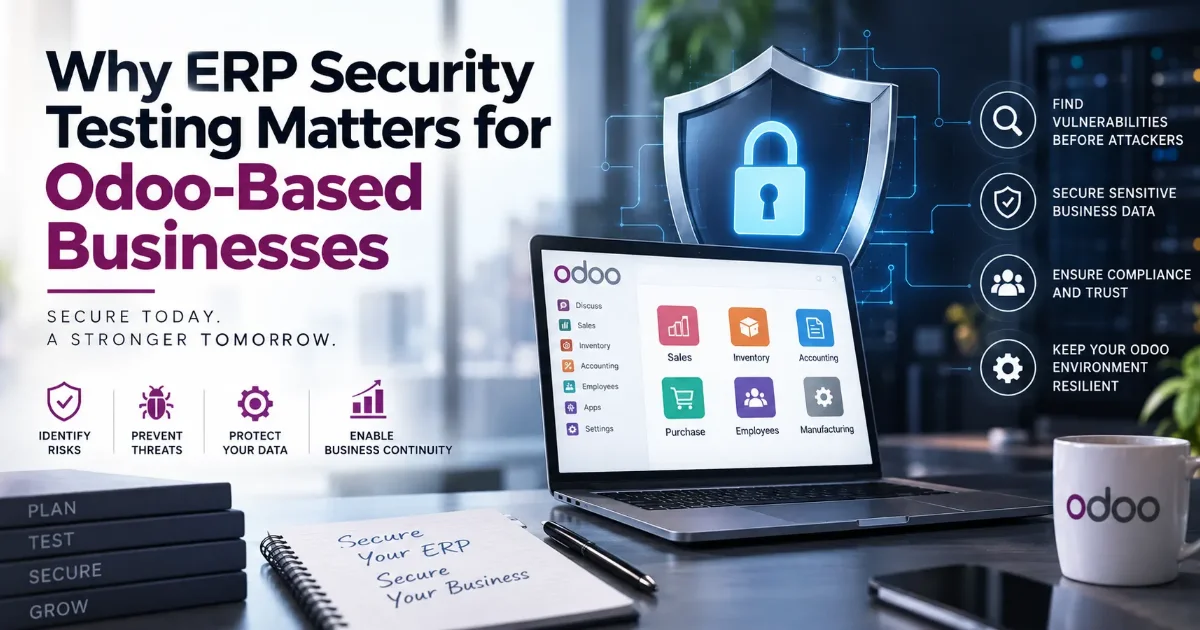
Why ERP Security Testing Matters for Odoo-Based Businesses
By: Ganesan D
21 Sep 2026
Category:
Penetration Testing
Introduction
Enterprise Resource Planning (ERP) systems have become central to modern business operations. They connect important functions such as sales, accounting, inventory, purchasing, manufacturing, human resources, and customer management within a single platform.
Because ERP platforms process large volumes of sensitive business information, their security is critical. A compromised ERP system could expose confidential data, disrupt business operations, or allow unauthorized users to perform sensitive actions.
For businesses using Odoo, Odoo ERP security should be treated as an ongoing priority. Proper configuration, access controls, secure development practices, regular updates, and Odoo security testing can help organizations identify weaknesses before they are exploited.
Importance of ERP Security
ERP systems often contain highly valuable information, including:
✔ Customer and supplier information
✔ Financial and accounting data
✔ Employee records
✔ Sales and purchase information
✔ Inventory details
✔ Business reports
✔ User credentials and access permissions
A security weakness in one area of an ERP system can potentially affect other connected business functions.
ERP security testing helps organizations identify vulnerabilities and assess whether security controls are working as intended.
Odoo Security Risks
Odoo provides extensive functionality and can be configured or customized to meet different business requirements. However, security risks can arise from improper configuration, vulnerable integrations, outdated components, excessive permissions, or insecure custom development.
Potential areas of concern include:
✔ Weak user access controls
✔ Excessive privileges
✔ Insecure authentication
✔ Poor password policies
✔ Misconfigured permissions
✔ Vulnerable custom modules
✔ Insecure APIs and integrations
✔ Exposed sensitive information
✔ Outdated software components
✔ Inadequate logging and monitoring
Organizations should consider both the standard Odoo environment and any custom modules or integrations when evaluating Odoo ERP security.
ERP Security Testing Areas
A comprehensive Odoo security testing process can evaluate multiple layers of the ERP environment.
Authentication Testing
Security teams can assess login mechanisms, password policies, session management, account controls, and authentication-related configurations.
Access Control Testing
Testing should verify whether users can access only the modules, records, functions, and information appropriate to their assigned roles.
API & Integration Testing
Odoo environments may integrate with payment platforms, websites, CRM systems, logistics applications, and other third-party services. These connections should be assessed for authentication, authorization, input validation, and data exposure risks.
Custom Module Testing
Custom-developed Odoo modules should be reviewed and tested for vulnerabilities introduced through custom code, workflows, permissions, or data handling.
Data Security Testing
Testing can examine whether sensitive business information is adequately protected from unauthorized access or exposure.
Configuration Review
Security teams can review ERP configurations, user privileges, security groups, access rules, and other settings that could affect the overall security posture.
Benefits of ERP Security Testing
Regular ERP penetration testing and security assessments can provide several benefits.
✔ Identify security vulnerabilities
✔ Detect excessive user privileges
✔ Validate authentication and access controls
✔ Identify weaknesses in custom modules
✔ Assess API and integration security
✔ Reduce potential attack paths
✔ Support compliance and security requirements
✔ Improve overall security visibility
Testing can also help organizations prioritize remediation based on the potential impact and severity of identified findings.
When Should You Test?
ERP security testing should not be treated as a one-time activity.
Organizations should consider testing:
✔ Before major ERP deployments
✔ After significant customizations
✔ After implementing new integrations
✔ Following major Odoo upgrades
✔ When access-control structures change
✔ After significant infrastructure changes
✔ As part of regular security assessments
The appropriate testing frequency depends on the organization's risk profile, environment, regulatory requirements, and rate of change.
Remediation
Identifying vulnerabilities is only the first step. Organizations should establish a structured remediation process after testing.
Remediation activities may include:
✔ Updating vulnerable components
✔ Correcting access permissions
✔ Strengthening authentication controls
✔ Fixing insecure custom code
✔ Securing APIs and integrations
✔ Removing unnecessary privileges
✔ Improving monitoring and logging
After fixes are implemented, retesting can help verify that vulnerabilities have been properly addressed.
Conclusion
For Odoo-based businesses, ERP security is closely connected to overall business security. Because Odoo can centralize financial, operational, customer, employee, and inventory information, weaknesses in the ERP environment can have significant consequences.
Odoo security testing and ERP security testing provide organizations with a structured way to identify vulnerabilities, validate security controls, and strengthen their ERP environment.