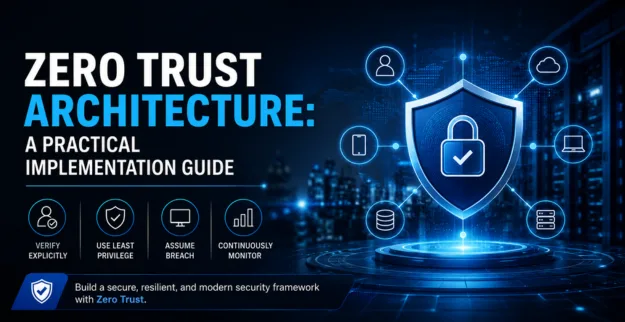
Zero Trust Architecture: A Practical Implementation Guide
25 August 2026
Introduction
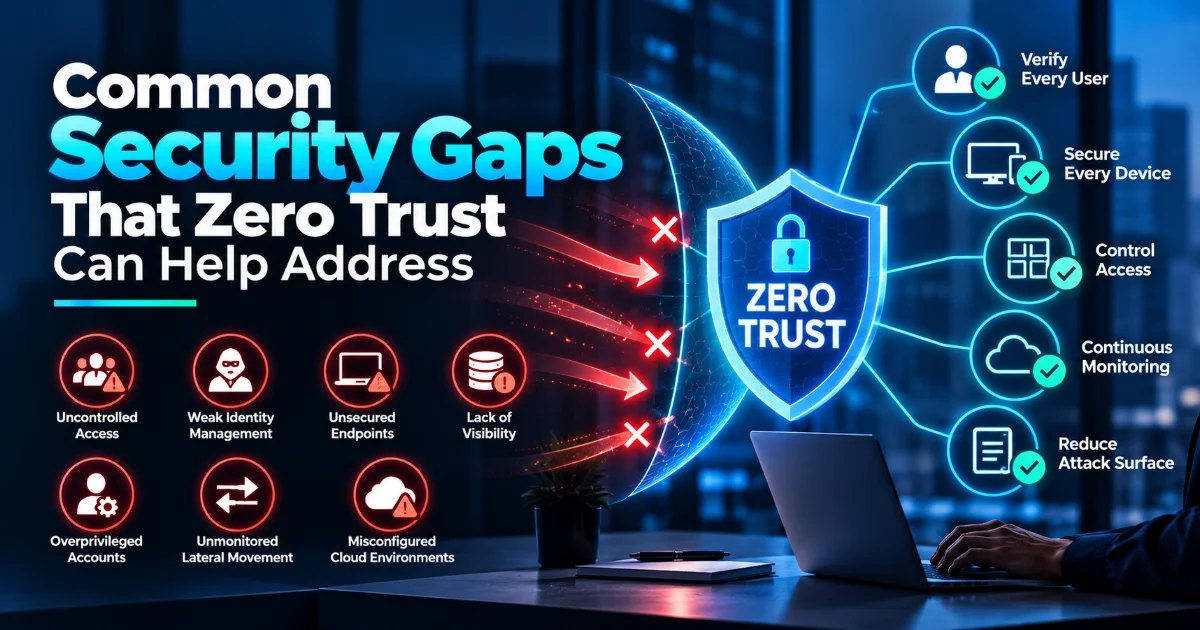
Traditional security models often assume that users and devices inside an organization's network can be trusted. However, modern businesses operate across cloud platforms, remote workplaces, mobile devices, third-party applications, and distributed networks. This makes perimeter-based security increasingly difficult to rely on.
Zero Trust Architecture provides a modern approach to cybersecurity by removing implicit trust and continuously verifying users, devices, applications, and access requests. By implementing Zero Trust Security and following a structured Zero Trust Framework, organizations can strengthen Identity Security, reduce unauthorized access, and better protect sensitive business resources.
What is Zero Trust?
Zero Trust is a security approach based on the principle that no user, device, application, or connection should automatically be trusted.
Instead of assuming that access is safe because someone is connected to the corporate network, Zero Trust requires authentication and authorization before access is granted.
Key Objectives
- Verify every access request
- Limit access to required resources
- Continuously monitor users and devices
- Reduce unauthorized access
- Protect critical business data
- Minimize the impact of compromised accounts
Zero Trust is not a single security product. It is an overall security strategy that combines identity, devices, networks, applications, and data protection.
Core Principles
A successful Zero Trust Framework is built around several fundamental principles.
Verify Explicitly
Every access request should be evaluated using factors such as identity, device security, location, application, and risk.
Least-Privilege Access
Users should receive only the permissions required to perform their responsibilities.
Assume Breach
Organizations should operate on the assumption that an attacker may already have access to part of the environment.
Continuous Monitoring
Users, devices, applications, and network activity should be continuously monitored for suspicious behavior.
Protect Data
Sensitive business information should be protected through access controls, encryption, classification, and monitoring.
These principles create multiple layers of Zero Trust Security across the organization.
Implementation Steps
Implementing Zero Trust should be approached gradually rather than attempting to change the entire environment at once.
Step 1: Identify Critical Assets
Identify sensitive data, applications, systems, users, and business processes that require strong protection.
Step 2: Strengthen Identity Security
Implement strong authentication, Multi-Factor Authentication (MFA), role-based access, and appropriate identity management controls.
Step 3: Apply Least Privilege
Review existing permissions and remove unnecessary access. Users should only have access to the resources required for their roles.
Step 4: Secure Devices
Ensure that laptops, desktops, mobile devices, and other endpoints meet defined security requirements before accessing business resources.
Step 5: Segment the Network
Separate critical systems and applications to limit lateral movement if an account or device is compromised.
Step 6: Monitor Continuously
Use security monitoring, threat detection, and analytics to identify unusual activity and potential security incidents.
Step 7: Protect Applications and Data
Apply appropriate access controls, encryption, and security policies to applications, cloud environments, and sensitive data.
Step 8: Test and Improve
Regularly assess the Zero Trust implementation, identify weaknesses, and update controls as business requirements and threats evolve.
Challenges
Although Zero Trust Architecture provides strong security benefits, implementation can present several challenges.
Legacy Systems
Older applications may not support modern authentication or access-control mechanisms.
Complex IT Environments
Businesses with multiple cloud platforms, applications, networks, and devices may find integration challenging.
User Experience
Additional authentication and security controls can affect user convenience if they are poorly designed.
Access Management Complexity
Organizations must continuously review permissions and ensure that access policies remain appropriate.
Implementation Costs
Zero Trust may require investment in identity management, endpoint security, network segmentation, monitoring, and security expertise.
A phased implementation can help organizations manage these challenges while gradually improving their security posture.
Conclusion
Zero Trust Architecture provides a practical approach to securing modern business environments where users, devices, applications, and data are distributed across multiple locations and platforms. By continuously verifying access, enforcing least privilege, monitoring activity, and assuming potential compromise, organizations can reduce their exposure to cyber threats.
Implementing Zero Trust Security is an ongoing process rather than a one-time project. By following a structured Zero Trust Framework and prioritizing Identity Security, businesses can build stronger defenses while supporting secure remote work, cloud adoption, and digital transformation.